In May, biohacker Bryan Johnson announced he’d been diagnosed with autoimmune gastritis — a condition that stops his stomach from doing the two things it needs to do to absorb vitamin B12 normally. That’s a strange twist for someone whose supplement company sells a multivitamin built around, among other things, a very large dose of B12.
So here’s the question worth actually answering: if your body loses the tools it needs to absorb a nutrient, does taking more of that nutrient in a pill still help? And if so, how much would you actually need?
This post contains affiliate links. If you make a purchase through them, we may earn a small commission — at no extra cost to you.
What Autoimmune Gastritis Actually Does to Your Stomach
Autoimmune gastritis is a condition where the immune system mistakenly attacks the cells lining the stomach — specifically the parietal cells, which make stomach acid, and a protein called intrinsic factor, which those same cells produce. Johnson’s diagnosis came after roughly a decade of unexplained low iron stores and a history of autoimmune thyroid disease — he didn’t have anemia or obvious symptoms at the time, and the condition was only confirmed through blood work, an endoscopy, and stomach biopsies.
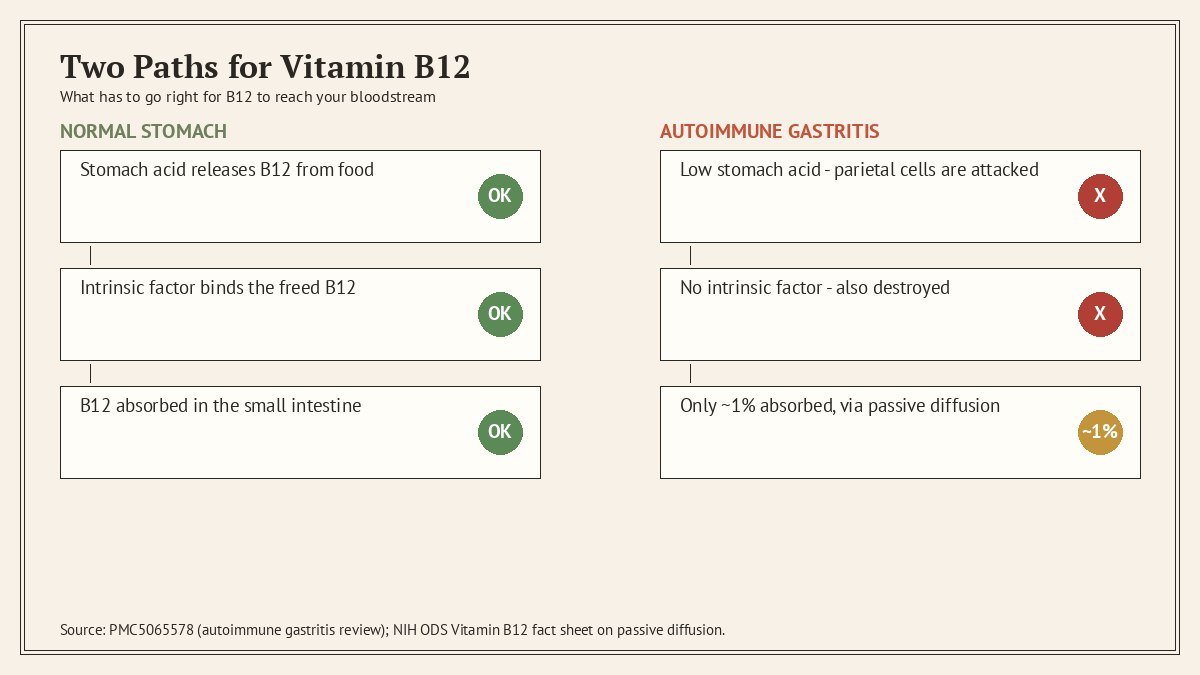
That combination — losing stomach acid and losing intrinsic factor at the same time — matters because both are required for the body to pull vitamin B12 out of food and get it into the bloodstream. Stomach acid separates B12 from the proteins it’s bound to in food. Intrinsic factor then escorts that freed B12 through the small intestine so it can be absorbed. Losing either one is a problem. Losing both, which is what happens in autoimmune gastritis, shuts down the main absorption route almost entirely.
That protein loss is exactly what makes B12 tricky — here’s why it isn’t necessarily game over for getting any B12 into your system at all.
Why Losing Intrinsic Factor Doesn’t Automatically Mean You Can’t Absorb Any B12
Here’s the part that surprises most people: intrinsic factor isn’t the only way B12 gets absorbed. There’s a second, much less efficient route called passive diffusion, where a small amount of B12 crosses the gut lining without needing intrinsic factor at all.
This article is for informational purposes only and is not medical advice. Talk to your doctor before starting any new supplement.
The 1% Rule Nobody Talks About
According to the National Institutes of Health’s Office of Dietary Supplements, only about 1% of an oral dose of B12 is absorbed through passive diffusion — and, importantly, this route stays intact even in people with pernicious anemia or autoimmune gastritis, because it doesn’t rely on intrinsic factor at all. It’s inefficient, but it’s not nothing.
So how much B12 do you actually need to take to make that 1% count?
What the Clinical Research Says About High-Dose Oral B12
This is where the math starts to matter. If only 1% of what you swallow gets absorbed, then a typical multivitamin dose isn’t going to move the needle much for someone who’s lost intrinsic factor. You need a genuinely large amount.
Clinical research backs this up. A review of oral B12 replacement in pernicious anemia found that 1,000 micrograms taken daily by mouth was enough to correct B12 levels about as well as injections — and a 2024 prospective cohort study found similar results using doses in the 1,000–2,000 microgram range. Run the numbers: at 1% absorption, a 1,000mcg dose delivers somewhere around 10 to 23 micrograms of B12 into the body — which turns out to be enough to correct a deficiency in people who can’t use the intrinsic-factor pathway at all.
With that number in hand, it’s worth looking at what’s actually in the bottle Bryan Johnson sells.
How Much B12 Is Actually in Bryan Johnson’s Essential Capsules
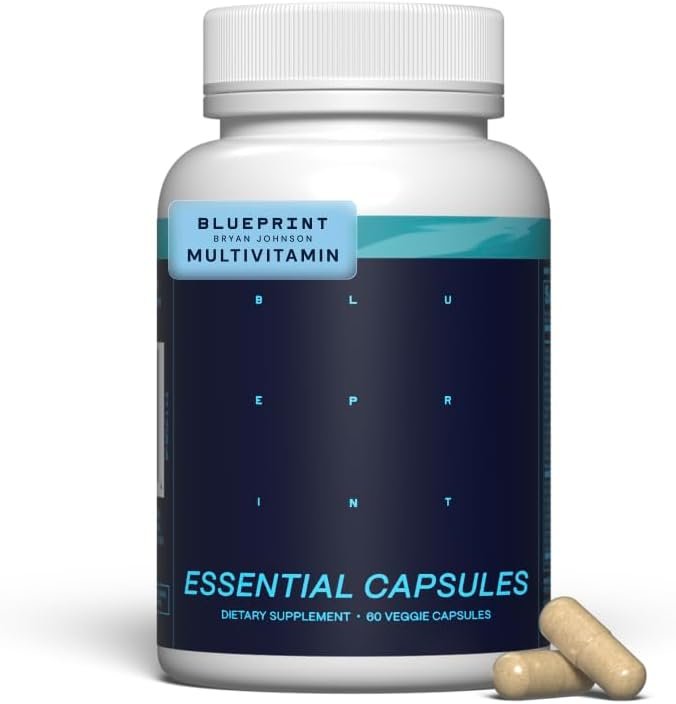
Johnson’s company, Blueprint, sells a daily multivitamin called Essential Capsules, taken as two capsules each morning. Its label lists 125 micrograms of B12 (as methylcobalamin) per serving — listed at 5,208% of the daily value, which sounds enormous on paper. Worth noting: the formula doesn’t contain any iron at all, which is a separate nutrient autoimmune gastritis can also affect, so this product isn’t attempting to address that side of things.
Doing the Math on Passive Absorption
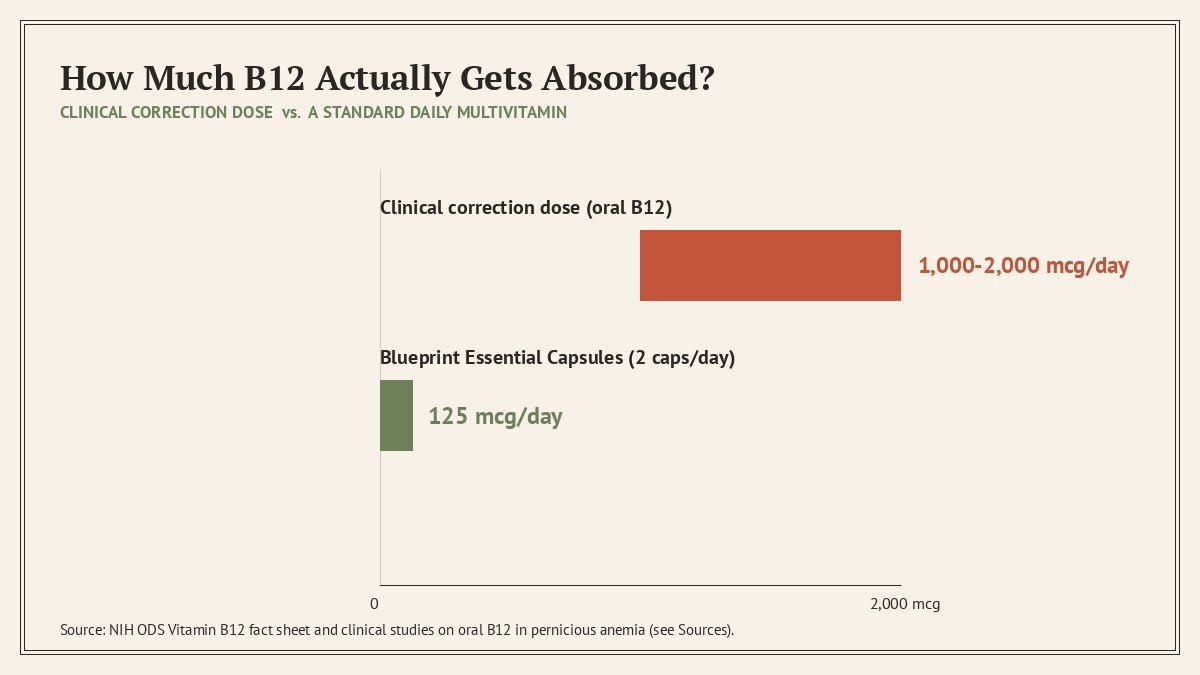
Applying the same 1% passive-diffusion estimate to 125mcg works out to roughly 1.25 micrograms absorbed per day. That’s a fine amount for someone with a normally functioning stomach — the general adult requirement is only about 2.4 micrograms a day. But it’s not close to the 10–23 micrograms per day that clinical studies used to correct a deficiency in people who’ve lost intrinsic factor. It’s a difference of a full order of magnitude.
So Does It Cover the Gap?
Based on the numbers, a standard multivitamin dose like this one looks built for general nutritional insurance, not for correcting the kind of absorption problem autoimmune gastritis causes. That’s not a knock on the product — it’s simply not designed or dosed for that specific situation, and there’s no public information suggesting it was marketed that way. What isn’t publicly known is whether Johnson uses additional B12 support beyond this multivitamin; his public statements haven’t detailed that part of his routine.
The broader takeaway holds regardless of any one person’s supplement stack: if you or someone you know has been told they have low stomach acid, intrinsic factor loss, or pernicious anemia, the research points toward needing either a high-dose oral B12 (in the 1,000mcg+ range) or an injectable form — not just whatever a standard multivitamin happens to contain. A bottle that promises “5,000% of your daily B12” can still fall short if your body has lost the tools that normally handle absorption. A multivitamin doesn’t automatically solve a diagnosis, even when the person selling it happens to have that diagnosis themselves.
Sources
- Bryan Johnson Diagnosed With Autoimmune Gastritis — Healthline
- Bryan Johnson’s diagnosis shines light on hard-to-detect disease — STAT News
- Autoimmune gastritis — PMC
- Vitamin B12 Health Professional Fact Sheet — NIH Office of Dietary Supplements
- Oral Vitamin B12 Replacement for the Treatment of Pernicious Anemia — PMC
- Oral vitamin B12 supplementation in pernicious anemia: a prospective cohort study — American Journal of Clinical Nutrition