Electrolyte powder has moved from the gym bag to the kitchen counter. People stir it into water after a run, on a hot day, or just because it tastes better than plain water. Whether you need it depends on how much you sweat and what the packet adds to your day. Here’s when electrolyte powder can help, and how to read the numbers on the label.
This post contains affiliate links. If you make a purchase through them, we may earn a small commission, at no extra cost to you.
This article is for general informational purposes only and is not medical advice. If you have high blood pressure, kidney disease, heart failure, or any condition that limits sodium, talk to your doctor before using electrolyte products.
When Electrolytes Actually Matter
Sweat carries water and sodium out of your body. For a short walk or a desk day, food and water cover that loss. Longer, harder, or hotter sessions are different. The American College of Sports Medicine’s position stand on exercise and fluid replacement says that during exercise, drinks containing electrolytes and carbohydrates can offer benefits over water alone under certain circumstances. After exercise, it says the goal is to replace any fluid and electrolyte deficit, and how aggressive that needs to be depends on how quickly you need to recover and how large the deficit is.
The same document notes you can estimate your own sweat loss by weighing yourself before and after exercise. That’s a more useful guide than a generic “drink more” rule, because sweat rates vary a lot from person to person.
Drinking more is not always safer, either. A 2015 consensus statement from 17 international experts names overdrinking, whether water, sports drinks, or other low-sodium fluids, as the primary cause of exercise-associated hyponatremia, a drop in blood sodium during or after exercise. Its safest general strategy is simple: drink palatable fluids when you’re thirsty. The point isn’t that electrolytes are risky. It’s that “more fluid, more of everything” isn’t a plan.
What One Stick Adds Up To
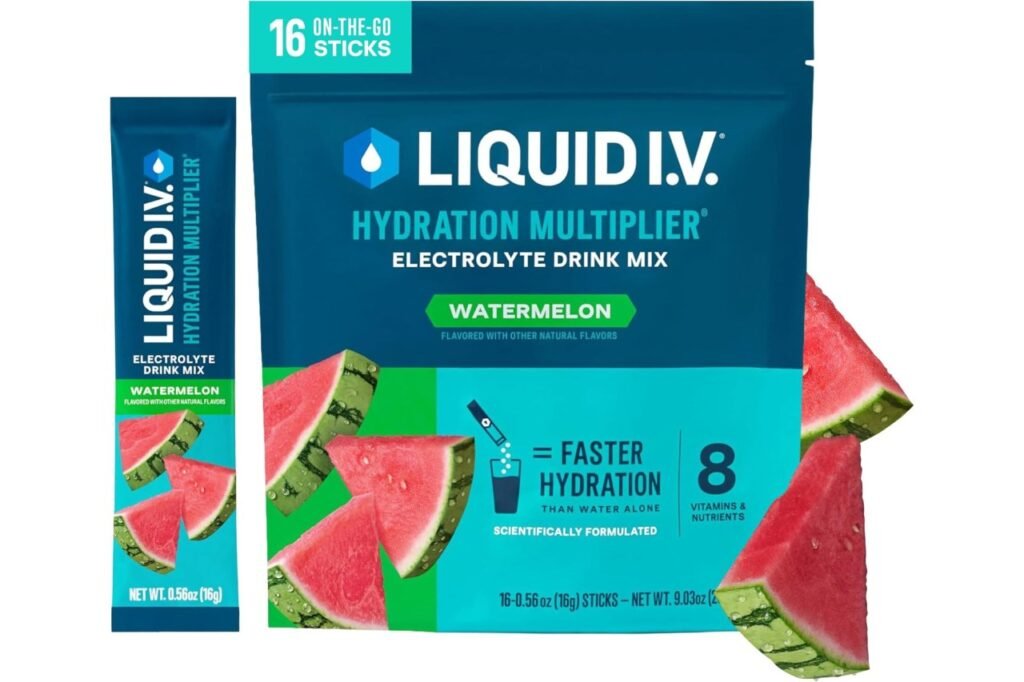
Take a popular example: Liquid I.V.’s Hydration Multiplier in Watermelon. One 16 g stick lists 50 calories, 11 g of added sugar, 370 mg of potassium, and 73 mg of vitamin C. Sodium is listed at about 500 to 530 mg, depending on the retailer listing, so check the box in your hands.
Those numbers matter once you set them against a full day. The American Heart Association recommends an ideal limit of 1,500 mg of sodium a day for most adults, and no more than 2,300 mg. One stick at roughly 500 mg is about a third of the first number and about a fifth to a quarter of the second. The AHA also notes that Americans average over 3,100 mg a day, and that more than 70% of it comes from packaged, prepared, and restaurant foods. So a stick on top of an ordinary day adds up quickly. The AHA adds that the 1,500 mg goal may not apply to people who lose large amounts of sodium in sweat, such as competitive athletes, or to anyone told otherwise by their healthcare team.
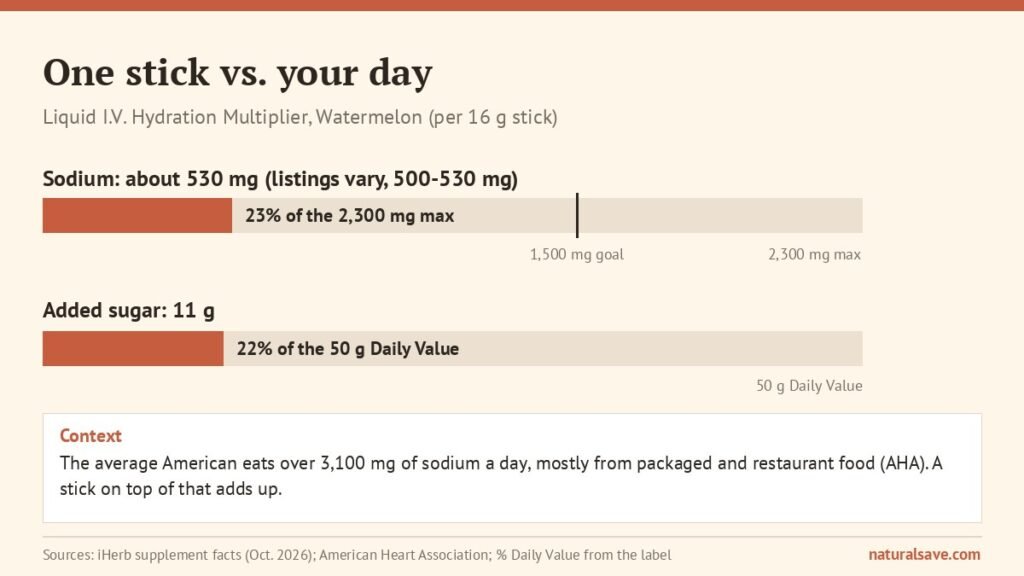
The 11 g of added sugar is about 22% of the 50 g daily value printed on the label. That’s modest next to a sugary drink, and we broke down how fast it climbs in our post on Dunkin’ Halloween drinks. But if you’re already having a flavored coffee or soda that day, a stick is one more serving on top.
We couldn’t find independent, peer-reviewed trials of this specific product. The brand points to its own clinical studies page, which is company-run, so treat claims like “hydrates faster than water” as marketing until independent data says otherwise.
A Quick Checklist Before You Buy
Electrolyte powder tends to make sense on days when you’ve lost a lot of fluid: a long workout or heavy sweating in the heat. It makes less sense as a daily habit on quiet days. A few checks help:
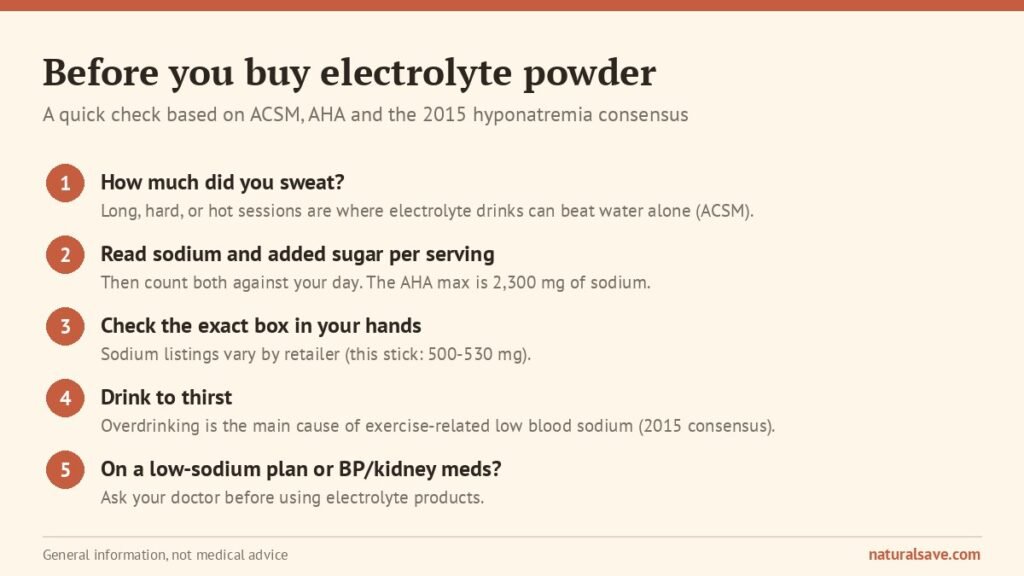
First, ask how much you sweated. If the answer is “not much,” water and a normal meal are usually enough. Second, read sodium and added sugar per serving, and count it against your day. Third, check the serving size and numbers on the exact box in your hands, since listings differ. Fourth, if you’re sensitive to sodium or take blood pressure or kidney medication, ask your doctor first. And as with any food product, a quick look at recall notices is worthwhile; our guide to the Gatorade dye recall shows how to check.
The Bottom Line
Electrolyte powder isn’t a magic hydrator, and it isn’t something most people need every day. It can help after long or hot workouts, per the ACSM, but each stick brings sodium and sugar that count against your daily totals. Liquid I.V. is one example of the category. Read the label, match the product to how much you actually sweated, and skip it on easy days.
Sources
- Sawka MN, et al. American College of Sports Medicine position stand. Exercise and fluid replacement. Medicine & Science in Sports & Exercise, 2007
- Hew-Butler T, et al. Statement of the 3rd International Exercise-Associated Hyponatremia Consensus Development Conference, Carlsbad, California, 2015. British Journal of Sports Medicine, 2015
- American Heart Association, How much sodium should I eat per day?
- iHerb, Liquid I.V. Hydration Multiplier Watermelon, supplement facts (viewed October 2026)
- Liquid I.V., Clinical studies (company page)