The beauty trend everyone’s calling “cloud skin” in 2026 is actually the opposite of the dewy glow most moisturizers promise — and that mismatch is exactly why the look can feel so hard to pin down. If you’ve searched for a cloud skin moisturizer hoping to find the one product that does it all, you’re not the only one confused: half the gel creams marketed for the trend describe a “dewy” or “luminous” finish, which is basically the look cloud skin is supposed to replace. Maybe you’ve already tried one of them, followed the routine on the label, and still didn’t get the soft, blurred effect you saw on TikTok. Here’s what the trend is actually built from, what a gel moisturizer is realistically doing for your skin, and how to tell the difference before you buy anything.
This post contains affiliate links. If you make a purchase through them, we may earn a small commission — at no extra cost to you.
This article is for informational purposes only and is not medical advice. Talk to a dermatologist before making changes to your skincare routine based on anything you read here.
What “Cloud Skin” Actually Means (It’s Not the Same as Dewy Skin)
For most of the early 2020s, the goal was shine. Glass skin, glazed donut skin, dolphin skin — different names for the same idea: a high-shine, light-reflecting finish. Cloud skin flips that. According to Who What Wear, which spoke directly with professional makeup artists about the trend, cloud skin describes a soft, blurred, velvety complexion with a gentle, diffused glow rather than an actual shine — closer to how a cloud catches light at golden hour than how a highlighter does.
Who What Wear spoke to professional makeup artists about what’s actually driving the look. Kristen Fortier, Makeup Artist & Product Innovation Lead for Crunchi Cosmetics, described the goal as “a no-filter-needed look” — something in between true matte and radiant, rather than the heavy, cakey coverage older matte foundations were known for. It’s less a brand-new invention than a swing back the other way after years of the “super dewy” trend dominating.
That’s the key distinction. Cloud skin isn’t dewy skin with a new name — it’s the industry’s answer to it, built mostly through a soft-focus, blurring foundation rather than a wet-looking finish.
So if cloud skin isn’t about a dewy glow, where does “hydrated, soft skin” — the thing every moisturizer promises — actually fit in?
▶ Watch Related Video (YouTube)
What a Moisturizer Can (and Can’t) Do for That Look
Gray’s own routine starts with skin prep, not the foundation. “You still want to keep your skin very hydrated and glowy underneath the makeup,” she told Who What Wear, recommending a lighter, gel-based moisturizer for oily skin and a heavier one for dry skin before any makeup goes on. In other words, a lightweight gel moisturizer genuinely has a role in building toward cloud skin — just not the role its marketing usually claims.
Worth knowing before you buy: a lot of the moisturizers riding the “cloud” name right now lean hard into dewy, luminous, plumping language — the exact aesthetic cloud skin is supposed to replace. If you’re shopping for a light, gel-based moisturizer to use as that prep step, Summer Fridays’ Cloud Dew Gel Cream Moisturizer is one option that comes up often — a fragrance-free gel cream built around hyaluronic acid, ceramide, and glycerin. But it’s still just the prep step. A moisturizer that promises “dewy” and “luminous” skin on the label isn’t working against you, exactly — it’s just describing a different finish than the one “cloud skin” is going for. The blurred, matte part of the look comes later, from a soft-focus foundation or a light dusting of powder, not from anything in a jar of moisturizer.
That raises a fair question: if a moisturizer’s own label promises a “dewy, luminous” finish, what is it actually doing under the skin? To answer that, it helps to look at what each ingredient is actually proven to do.
Grading the Ingredients: What’s Actually Backed by Research
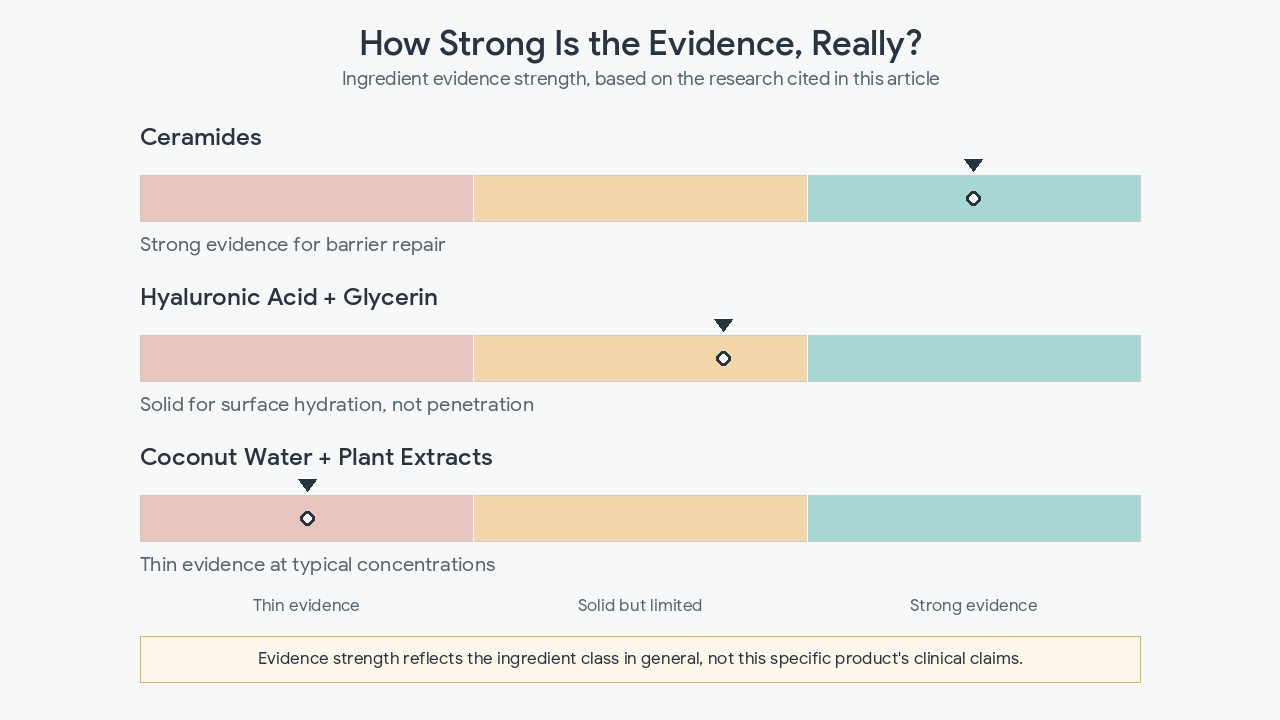
Not every ingredient on a moisturizer’s label is doing the same amount of work. Here’s roughly how the evidence stacks up for the ones that show up most often in gel-cream formulas.
Ceramides — the ingredient with the strongest barrier-repair evidence
Ceramides are lipids that make up a big part of your skin’s outer barrier — think of them as the “mortar” holding your skin cells together. When ceramide levels drop, water escapes through the skin faster (a process called transepidermal water loss, or TEWL), and skin gets drier and more reactive.
A 2024 clinical study published in Cosmoderma tested a ceramide-containing lotion on 32 adults with dry skin and found hydration levels rose from a baseline of 13.57 to 31.61 at 12 hours and 36.36 at 24 hours after application (a statistically significant increase), with less water loss through the skin over the same period. That study wasn’t testing this specific gel-cream, but it’s a solid example of what ceramides as an ingredient class can realistically do for barrier repair.
Hyaluronic acid and glycerin — solid for surface hydration, not for deep penetration
Hyaluronic acid (HA) has a real reputation for holding onto water, and that reputation is earned. But according to a study published in The Journal of Clinical and Aesthetic Dermatology, ordinary HA formulated into a standard cream base is too large a molecule to get past the skin’s surface — it stays on top and functions as a surface moisturizer rather than sinking in. The researchers only achieved deeper penetration by micronizing the HA molecules into a much smaller size, something most drugstore and prestige moisturizers don’t specify doing.
If you check a label for this kind of ingredient combination, Cloud Dew lists sodium hyaluronate and hydrolyzed sodium hyaluronate alongside glycerin and ceramide NP — a fairly standard barrier-and-hydration lineup, without any claim of special penetration technology. (Brands in this category sometimes cite their own clinical testing, too — its own product page reports that 100 percent of participants in a brand-commissioned study of 35 people saw measurable improvement in skin hydration. That’s worth reading as a small, company-run study rather than independent peer-reviewed research, but it’s not inconsistent with what ceramides and HA are known to do at a surface level.) Glycerin, meanwhile, is one of the oldest and most consistently proven humectants in skincare — it just doesn’t get the marketing attention that newer-sounding ingredients do.
Coconut water and plant extracts — bigger on the label than in the evidence
Coconut water shows up in a lot of 2026 reformulations, usually marketed as a hydration booster alongside fruit extracts. According to dermatologists quoted by Healthline, coconut water does contain electrolytes and antioxidants that are plausible for skin health in theory — but the amounts typically used in skincare formulas are too low to produce a noticeable brightening or hydrating effect on their own. It’s a reasonable supporting ingredient, not a replacement for the ones doing the heavier lifting.
None of this means a gel moisturizer is pointless — it just means the expectations should match what the ingredients can realistically do.
How to Actually Work Toward “Cloud Skin”
Based on what makeup artists told Who What Wear, building the look is less about one product and more about layering in the right order:
- Prep with the right moisturizer for your skin type. A lighter, gel-based formula for oily skin; a richer one for dry skin. This is where hydration actually happens.
- Add a primer. Makeup artist Kristen Fortier recommends a primer at this stage specifically to soften the look of pores and fine lines and help makeup grip through the day.
- Finish with a soft-matte foundation, applied thin. This is the step that actually creates the blurred, “lit from within” effect — not the moisturizer underneath it.
Skipping straight to a heavier matte foundation without the hydration step tends to look flat and cakey, which is the exact look 2026’s soft-focus formulas are trying to avoid.
The Bottom Line
Cloud skin and a “dewy” moisturizer aren’t actually describing the same thing, and that’s the mismatch that makes the trend confusing to shop for. A lightweight, well-formulated gel moisturizer can absolutely be part of getting there — it’s just doing the hydration and prep work, not the blurring and matte finish that gives cloud skin its name.
Next time you’re comparing gel creams, skip past the “dewy” and “luminous” language on the front of the jar and check the ingredient list instead. Ceramides for barrier support, plus hyaluronic acid and glycerin for surface hydration, are the parts actually doing the work — everything else on the label is a bonus, not the main event. Then let a soft-matte foundation or a light dusting of powder handle the finish on top. Match each product to the job it’s actually built for, and the “cloud skin” part takes care of itself.
That mismatch between what a “cloud” product promises and what “cloud skin” actually looks like is the whole reason this trend is confusing to shop for in the first place. Once you know which step a moisturizer is really handling, it’s a lot easier to stop expecting one jar to do a foundation’s job.
Sources
- Who What Wear — “2026’s ‘Cloud Skin’ Trend Puts This 2016-Era Foundation Front and Center”
- The Journal of Clinical and Aesthetic Dermatology — “Topical Hyaluronic Acid Facial Cream with New Micronized Molecule Technology…”
- Cosmoderma — “Clinical evaluation of a topical ceramide lotion on skin hydration and skin barrier in healthy volunteers with dry skin”
- Healthline — “Benefits of Coconut Water for Skin”
- Summer Fridays — Cloud Dew® Gel Cream Moisturizer product page