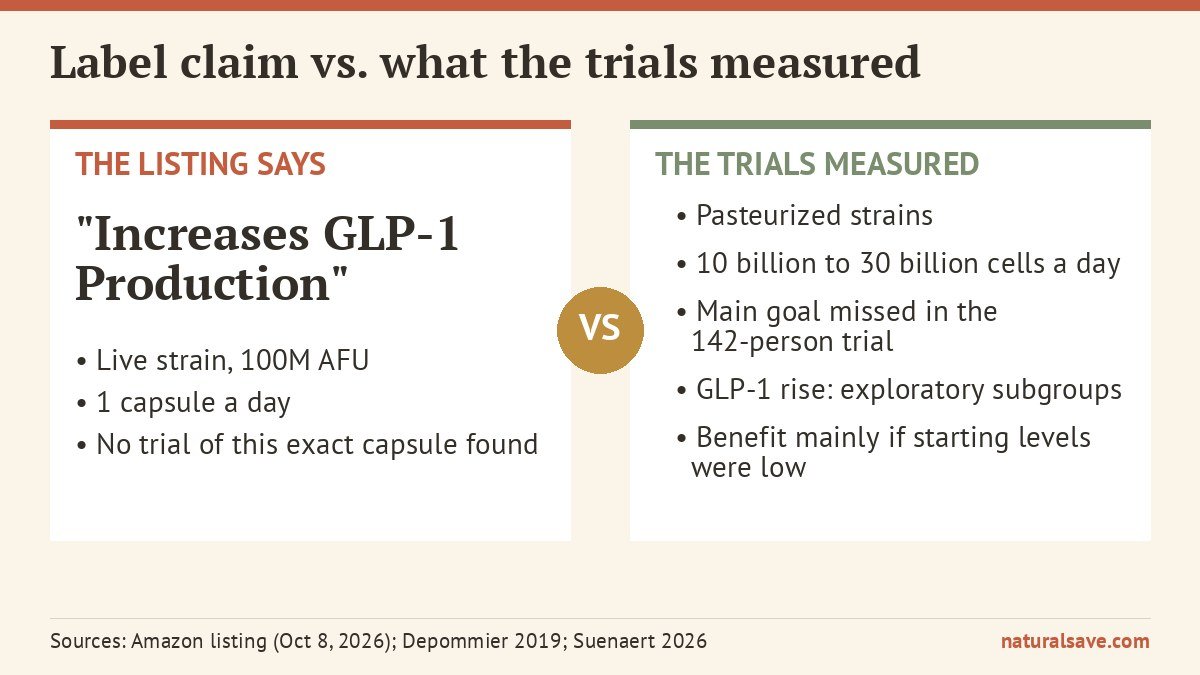
The Amazon listing for one popular Akkermansia capsule says it “Increases GLP-1 Production.” It’s a bold line, especially now that GLP-1 drugs are everywhere. But the human trials behind Akkermansia tell a narrower story, and the details matter if you’re deciding whether a $2-a-day capsule belongs in your routine.
This article is for general informational purposes only and is not medical advice. Talk to your doctor before starting any new supplement. This post also contains an affiliate link. If you make a purchase through it, we may earn a small commission, at no extra cost to you.
What “GLP-1 Supplement” Actually Means
GLP-1 is a hormone your gut releases after you eat. It helps your pancreas release insulin and slows how fast your stomach empties. GLP-1 drugs mimic that hormone at medicine-level doses. A supplement can’t do that, and the companies selling them say so. When Pendulum launched its multi-strain GLP-1 Probiotic in 2024, the press release stated that it “does not contain GLP-1” and “is not a GLP-1 agonist drug.”
The idea instead is that certain gut bacteria might nudge your own gut cells to release more of the hormone. Akkermansia muciniphila is a gut bacterium that tends to be lower in people with obesity and type 2 diabetes. The same press release describes the GLP-1 claim as “based on preclinical studies,” meaning lab and animal work. That’s a reasonable starting point for research. It isn’t the same as showing the effect in people who take a capsule.
The First Human Trial Used a Pasteurized Strain
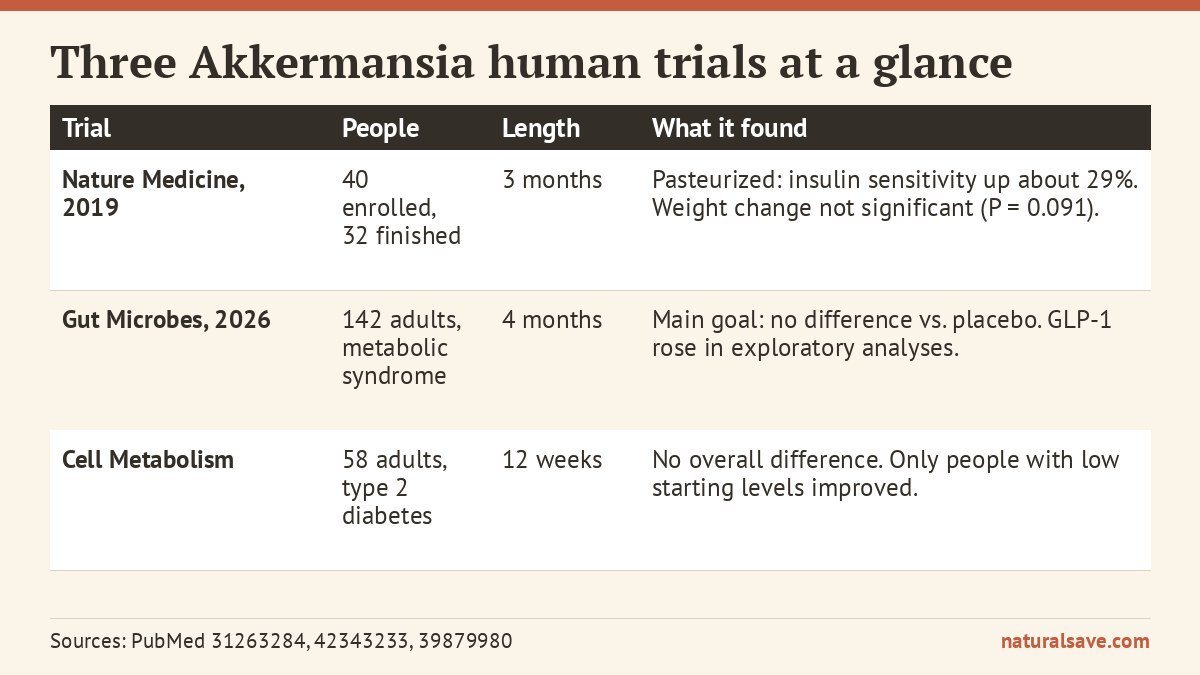
The trial most often cited is a 2019 pilot study in Nature Medicine. Forty overweight or obese adults with insulin resistance were enrolled, and 32 finished. They took about 10 billion bacteria a day for three months, either live or pasteurized (heat-treated) Akkermansia, or a placebo. Both forms were safe and well tolerated.
The improvements the paper reports are for the pasteurized form. Compared with placebo, insulin sensitivity rose by about 29%, insulin levels fell by about 34%, and total cholesterol dropped by about 9%. Body weight fell by 2.27 kg, but that result was not statistically significant (P = 0.091). The authors called it a proof-of-concept study, and GLP-1 was not among the results in the abstract.
The Trial That Measured GLP-1
A larger, 2026 study in Gut Microbes did measure GLP-1. It enrolled 142 adults with metabolic syndrome and gave them 30 billion cells a day of a pasteurized strain, or a placebo, for four months. The main goal, improving whole-body insulin sensitivity, did not differ from placebo.
The GLP-1 finding came from follow-up analyses that were exploratory. After three months, the supplement improved a liver insulin-sensitivity measure in the prediabetic and older subgroups, and GLP-1 levels after a glucose drink rose more than with placebo. The clearest gains showed up in people who started with low levels of Akkermansia in their gut. In that group, GLP-1 response and insulin sensitivity improved, body weight trended down (p = 0.06), and trunk fat fell.
A 12-week trial in Cell Metabolism found the same pattern in 58 people with overweight or obesity and type 2 diabetes. Both groups lost weight and lowered HbA1c, with no significant difference between them. Only participants with low starting levels of Akkermansia improved on the supplement. In people with high starting levels, the bacteria colonized poorly and showed no significant clinical improvement. The researchers measured those starting levels in each participant, something a capsule label can’t do for you. If you’re curious how another lab marker can rise without changing how you feel, we covered the same gap with NAD+ supplements.
What That Means for a Capsule on the Shelf
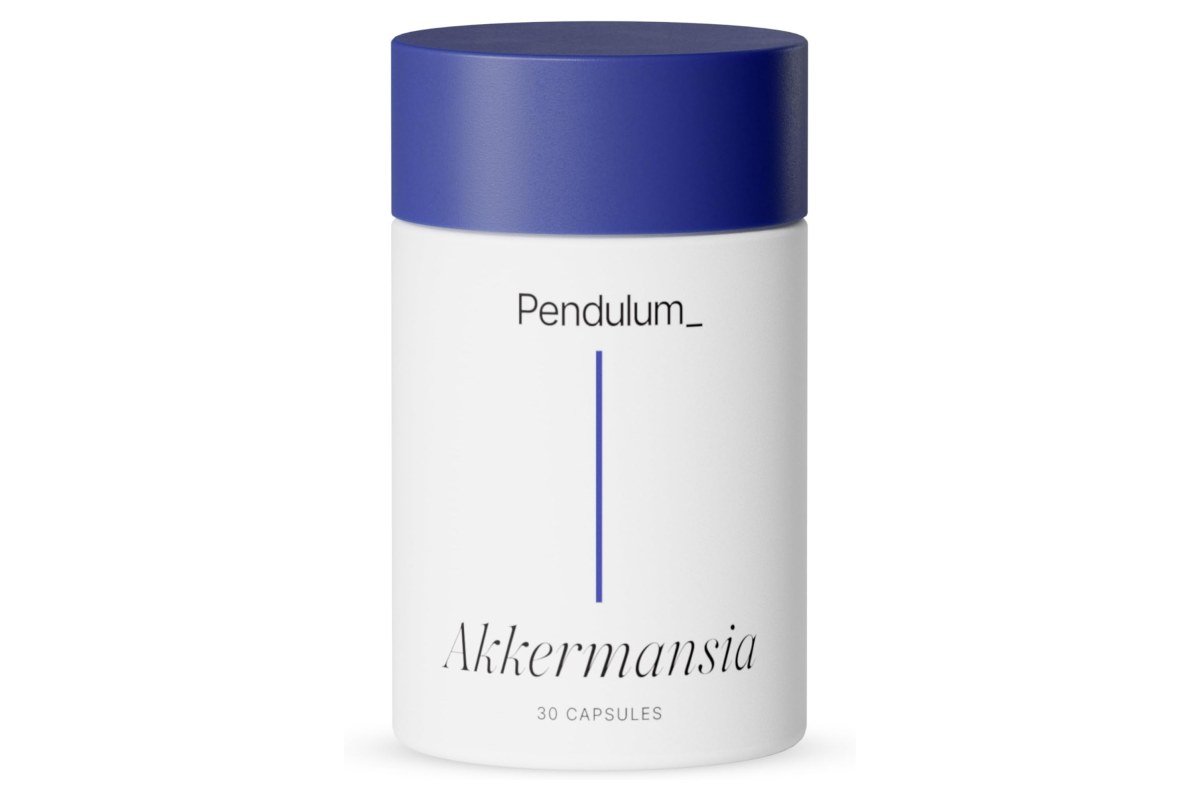
The capsule that prompted this article, Pendulum Akkermansia, contains Akkermansia muciniphila and chicory inulin. Its listing describes a “100M AFU Live Strain,” taken once a day. That’s a different product from what these trials tested. The 2019 and 2026 trials above used pasteurized strains, and their doses were reported in cells (10 billion and 30 billion) rather than AFU, a live-count unit, so the numbers can’t be compared directly. We found no published trial that tested this specific capsule for GLP-1.
Pendulum has published one human trial, but it tested another product. A 2020 study in BMJ Open Diabetes Research & Care gave 76 adults with type 2 diabetes a five-strain formula called WBF-011 for 12 weeks. After meals, their blood sugar curve was lower than placebo (p = 0.0500), and HbA1c fell by 0.6, a secondary result. The authors noted the small sample and called for larger studies. It measured blood sugar, not GLP-1.
Price is the other piece. On Amazon on October 8, 2026, this capsule was $64 for 30, or $2.13 each. Another Akkermansia product with the same 100M AFU listed was $0.33 a capsule. With no head-to-head data, there’s no way to know whether the strains perform alike, so the price gap is a fact to weigh and not a verdict. Our look at probiotic CFU counts covers why bigger numbers on a label don’t settle the question.
The Bottom Line
“Increases GLP-1 Production” is a headline that outruns the evidence. The human trials are small, mostly tested a pasteurized strain, and found GLP-1 changes in exploratory subgroups, mainly in people who start with low Akkermansia levels. That’s interesting science and a long way from a proven result for a live-strain capsule. If you take diabetes medication or a GLP-1 drug, talk to your doctor before adding something marketed for blood sugar or appetite, and don’t treat any capsule as a substitute for treatment.
Sources
- Depommier et al., Supplementation with Akkermansia muciniphila in overweight and obese human volunteers: a proof-of-concept exploratory study (Nature Medicine, 2019)
- Suenaert et al., Effect of pasteurized Akkermansia muciniphila MucT on insulin sensitivity, body composition, and GLP-1 production in subjects with metabolic syndrome (Gut Microbes, 2026)
- Akkermansia muciniphila supplementation in patients with overweight/obese type 2 diabetes: Efficacy depends on its baseline levels in the gut (Cell Metabolism)
- Improvements to postprandial glucose control in subjects with type 2 diabetes: a randomized placebo-controlled trial of a novel probiotic formulation (BMJ Open Diabetes Research & Care, 2020)
- Pendulum Therapeutics Introduces GLP-1 Probiotic (press release, 2024)