Tea tree oil helping with acne isn’t marketing spin — the research backs it up. But that research was done with a gel left on the skin all day, not a face wash that’s rinsed off in under a minute. That gap matters more than most labels let on.
If you’ve ever wondered whether your tea tree face wash is actually doing what the studies promise, or just smelling like it is, here’s what the evidence says about what a wash can and can’t do, and why the soap it’s built on might be working against you a little.
This post contains affiliate links. If you make a purchase through them, we may earn a small commission — at no extra cost to you.
What the Tea Tree-Acne Studies Actually Tested
This article is for informational purposes only and is not medical advice. Talk to a dermatologist before starting any new skincare routine, especially if you have sensitive or acne-prone skin.
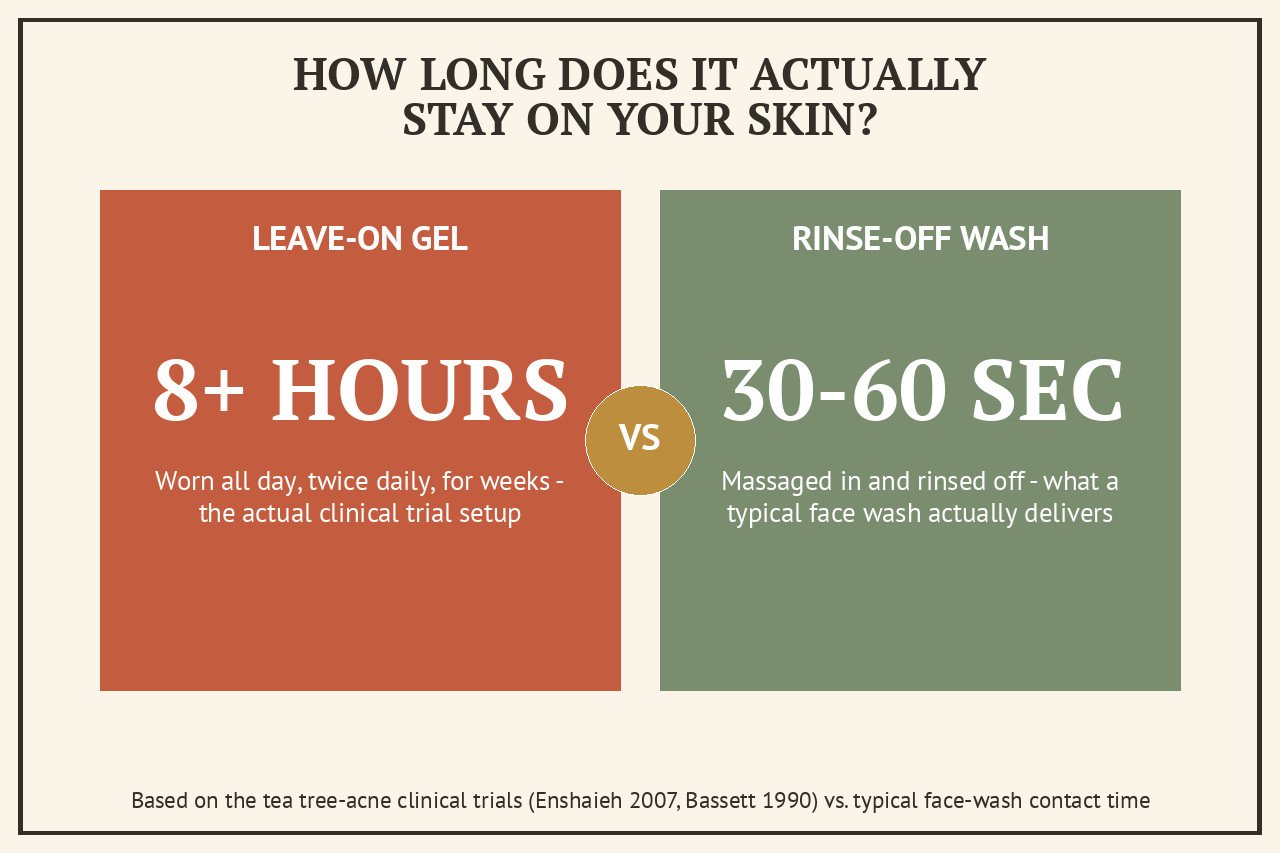
The clearest evidence for tea tree oil and acne comes from two studies, and both used the same basic setup: a concentrated gel applied directly to the skin and left there. In a randomized, double-blind trial described in a review of tea tree oil research, 60 patients with mild to moderate acne used a 5% tea tree oil gel twice daily for 45 days. The result was a 3.55-fold reduction in total lesion count compared to placebo, and a 5.75-fold improvement in overall acne severity — though it took around 30 days before the improvement became visible.
An earlier head-to-head trial compared 5% tea tree oil gel against 5% benzoyl peroxide lotion in 124 patients over three months. Benzoyl peroxide worked faster, showing measurable improvement by weeks 4 and 8. Tea tree oil caught up by week 12, and by the end of the study the two were roughly comparable on lesion reduction — but tea tree oil caused noticeably less dryness, burning, and peeling along the way.
Both studies point to the same active mechanism: terpinen-4-ol, the main antibacterial compound in tea tree oil, which disrupts the cell membranes of acne-related bacteria. But that mechanism needs time on the skin to work. Twice-daily application, left on for hours, is what these numbers are actually measuring.
Why a Rinse-Off Cleanser Is a Different Story
Here’s the disconnect: most tea tree products people actually use aren’t gels you leave on. They’re face washes, massaged in for about a minute and rinsed off. That’s a fundamentally different exposure than what the studies tested.
A cleanser’s contact time with your skin is measured in seconds, not hours. Terpinen-4-ol needs sustained contact to disrupt bacteria living in and around the follicle — a wash that’s down the drain in under a minute doesn’t give it much of a window. On top of that, most tea tree face washes don’t disclose their tea tree oil percentage, so there’s no way to know if a given product is anywhere close to the 5% concentration the clinical trials used.
None of this means a tea tree face wash does nothing. It just means the honest expectation is “gentle daily cleanser,” not “acne treatment,” since the clinical benefit was built around a completely different way of using the ingredient.
The Castile Soap Base Adds Its Own Wrinkle
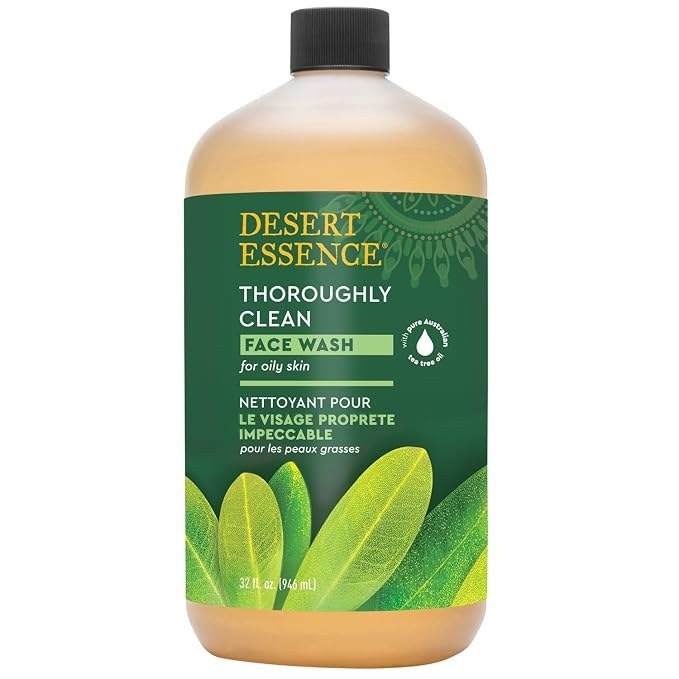
There’s a second factor worth knowing about, and it has nothing to do with tea tree oil at all. Many natural face washes, including Desert Essence Thoroughly Clean Face Wash, are built on a Castile soap base — a traditional soap made by saponifying plant oils. Castile soap is naturally alkaline, typically sitting around pH 9 to 10, while healthy skin sits closer to pH 4.5 to 5.5.
That acidic range is what dermatologists call the acid mantle, and it plays a real role in keeping moisture in and irritation out. When a cleanser pushes skin pH upward, that protection can temporarily loosen, and skin may lose moisture more easily or feel more reactive. Healthy skin usually restores its own pH within a few hours through normal oil and sweat production, but frequent washing with an alkaline soap can slow that recovery for some people.
This lines up with something visible right in the product’s own customer reviews: dryness and skin irritation are two of the most frequently mentioned complaints, alongside praise for how thoroughly it cleans. That’s not proof the soap base is solely to blame, but the pattern fits the pH mechanism described above.
So What Can (and Can’t) This Kind of Face Wash Do for You
Used as what it actually is — a gentle daily cleanser with a mild antibacterial botanical mixed in — a wash like Desert Essence’s tea tree face wash is a reasonable choice for oily or acne-prone skin that doesn’t tolerate harsher surfactants well. It’s not unreasonable to expect a cleaner, less oily feel after washing. What’s not reasonable is expecting the same lesion reduction seen in trials that used a 5% leave-on gel for weeks at a time.
If you’re dealing with more than occasional breakouts, the research suggests a leave-on active — benzoyl peroxide, salicylic acid, or a proper tea tree gel at a disclosed concentration — is doing the clinical-strength work, with a gentle cleanser like this one playing a supporting role rather than the main event. If you already lean on spot treatments, it’s worth knowing that not every acne product works the same way either — we broke down how pimple patches perform across different types of blemishes in a separate piece.
Because a wash like this is built around several essential oils on top of the tea tree — lavender, calendula, palmarosa, bitter orange peel — it’s worth doing a patch test on your inner arm before using it on your whole face, especially if you have known fragrance sensitivities.
The Bottom Line
Tea tree oil’s reputation for helping acne is earned — but it’s earned by a leave-on gel worn for hours, not a wash rinsed off in under a minute. A tea tree face wash like this one can still be a gentle, reasonable part of an oily-skin routine, especially if your skin doesn’t do well with stronger cleansers. Just don’t expect it to replace the leave-on treatments the actual studies were testing, and if dryness shows up after a few weeks, that’s worth paying attention to rather than pushing through.
Sources
- Healthline. “Can Tea Tree Oil Help Get Rid of Acne?”
- Dr. Bronner’s. “Skin pH, Soap & the Microbiome: How Castile Soap Cleans.”
- Enshaieh S, et al. “The efficacy of 5% topical tea tree oil gel in mild to moderate acne vulgaris: a randomized, double-blind placebo-controlled study.” Indian J Dermatol Venereol Leprol. 2007.
- Bassett IB, Pannowitz DL, Barnetson RS. “A comparative study of tea-tree oil versus benzoylperoxide in the treatment of acne.” Med J Aust. 1990.