A 2018 study put cottage cheese to the test before bed — and the results weren’t what the trend promised.
If you’ve spent any time on social media lately, you’ve probably seen the claim: eat a bowl of cottage cheese before you go to sleep, and you’ll wake up leaner, more recovered, ready to build muscle overnight. It’s become one of those tips that gets repeated so often it starts to sound like settled science. It isn’t, exactly — and the actual research on this is more specific, and more interesting, than the trend lets on.
This post walks through what the one study that actually tested cottage cheese before bed found, where the “protein before sleep” idea really comes from, and what’s worth knowing about a serving beyond the protein number.
This post contains affiliate links. If you make a purchase through them, we may earn a small commission — at no extra cost to you.
What’s Actually in a Serving of Cottage Cheese
This article is for informational purposes only and is not medical advice. If you have high blood pressure, kidney disease, or take medication affected by sodium or potassium intake, talk to a doctor before making significant changes to your diet.
A half-cup (118g) serving of Breakstone’s Large Curd 4% Milkfat Cottage Cheese contains 120 calories, 12g of protein, 5g of total fat (3.5g saturated), 6g of carbohydrates, and 350mg of sodium — 15% of the recommended daily value, along with 130mg of calcium. Publix’s own product listing for the same item confirms the 12g protein figure, which is a genuinely solid number for 120 calories.
The sodium isn’t a flaw in this particular brand — it’s baked into how cottage cheese is made. The curds are salted during processing, both for flavor and to help control texture and shelf life, so a certain amount of sodium comes with the format itself rather than being something a “healthier” cottage cheese would simply leave out.
That protein number is exactly why cottage cheese got tagged as a pre-sleep food in the first place — so does the science actually back that up?
The Pre-Sleep Study That Actually Used Cottage Cheese
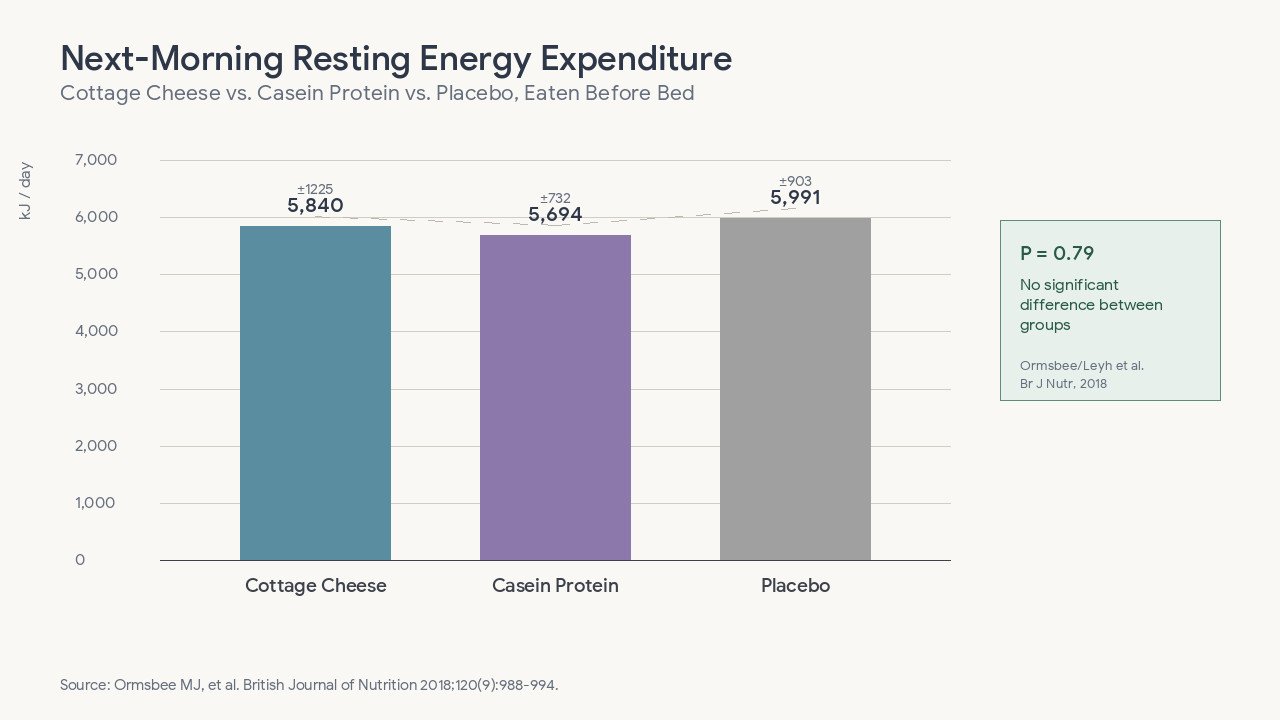
Here’s the part that tends to get skipped in the trend version of this story. A 2018 randomized, cross-over study published in the British Journal of Nutrition specifically tested cottage cheese eaten 30–60 minutes before bed in ten active women, comparing it against an energy- and protein-matched casein protein beverage and a zero-calorie placebo. Researchers measured resting energy expenditure and hunger both that night and the next morning.
The result: no statistically significant difference between cottage cheese, the casein beverage, and the placebo in next-morning resting energy expenditure, respiratory exchange ratio, or subjective hunger ratings. The paper’s own title says it plainly: pre-sleep protein, in either form, had no impact on resting energy expenditure or hunger. Eating cottage cheese before bed didn’t make participants burn more calories overnight or feel less hungry the next morning compared to drinking a protein shake — or compared to eating nothing at all.
So if cottage cheese itself doesn’t move the needle on next-morning metabolism — where did the “protein before bed helps recovery” idea even come from?
Where the “Protein Before Bed” Idea Actually Comes From
The research behind the trend is real — it’s just about casein protein in general, not cottage cheese specifically. A study published in Medicine & Science in Sports & Exercise had sixteen young men consume 40g of casein protein before sleep after a session of resistance exercise, then tracked overnight muscle protein synthesis. Whole-body protein synthesis was significantly higher in the group that drank the casein beverage, and muscle protein synthesis rates ran about 22% higher as well — though that particular difference sat right at the edge of statistical significance (P=0.05).
That’s a real, measurable effect — but it came from a concentrated casein protein drink in resistance-trained men, not from a bowl of cottage cheese in the general population. Casein happens to be the dominant protein in cottage cheese too, which is probably how the two ideas got merged into one internet-friendly tip. If you’re looking for a whole-food way to get casein protein into your evening routine anyway, Breakstone’s Large Curd Cottage Cheese is a straightforward option — not because the specific research says cottage cheese does something unique overnight, but because it’s a convenient, high-protein food if you’re already eating a bedtime snack.
That leaves one more thing worth checking before deciding whether cottage cheese belongs in your nightly routine — what’s actually in a serving beyond the protein.
The Catch: Sodium and Saturated Fat You Might Not Notice
Cottage cheese’s low-calorie, high-protein reputation can make it easy to overlook what else is in the tub. Qi Sun, an associate professor of nutrition and epidemiology at Harvard T.H. Chan School of Public Health, has said he isn’t confident cottage cheese is meaningfully different from other cheeses in this respect — most cheese, cottage cheese included, comes with real sodium and fat alongside its nutrients. Eric Rimm, a professor of epidemiology at the same school, has compared cottage cheese’s sodium content to bread’s — one of those foods where the salt is easy to underestimate — and specifically recommended that people with high blood pressure be careful with how much they eat.
At 350mg of sodium and 3.5g of saturated fat per half-cup, a single serving of Breakstone’s isn’t extreme, but it also isn’t the “guilt-free” number some social media posts imply. If you’re eating it daily as a snack rather than occasionally, that adds up the same way any salty food does. Choosing a lower-fat version and skipping any added-sugar varieties is the adjustment Eric Rimm specifically suggested if sodium and saturated fat are a concern — a reasonable reason to check the label on whichever cottage cheese ends up in your cart.
The Bottom Line
That 2018 study didn’t find anything wrong with cottage cheese — it just found that eating it before bed doesn’t do anything special that eating nothing, or drinking a protein shake, wouldn’t also do. The “protein before sleep helps recovery” research is real, but it comes from casein protein in general, tested in a very specific context, not from cottage cheese as its own overnight superfood.
What’s left is a genuinely useful, high-protein food that happens to also come with real sodium and saturated fat — worth having in the rotation for what it actually is, not for a pre-sleep effect the one study that tested it couldn’t find. If you’re deciding whether to add it to your evening routine, base that decision on the protein-per-calorie math and the sodium on the label, not on a metabolism boost the research doesn’t support.
Sources
- Ormsbee MJ, et al. “Pre-sleep protein in casein supplement or whole-food form has no impact on resting energy expenditure or hunger in women.” Br J Nutr. 2018;120(9):988-994.
- Res PT, et al. “Protein ingestion before sleep improves postexercise overnight recovery.” Med Sci Sports Exerc. 2012;44(8):1560-9.
- Harvard T.H. Chan School of Public Health. “Is cottage cheese healthy?”
- MyFoodDiary. Nutrition Facts for Breakstone’s Large Curd Cottage Cheese w/ 4% Milkfat.
- Publix. Breakstone’s Cottage Cheese, 4% Milkfat Min, Large Curd — Product Page.