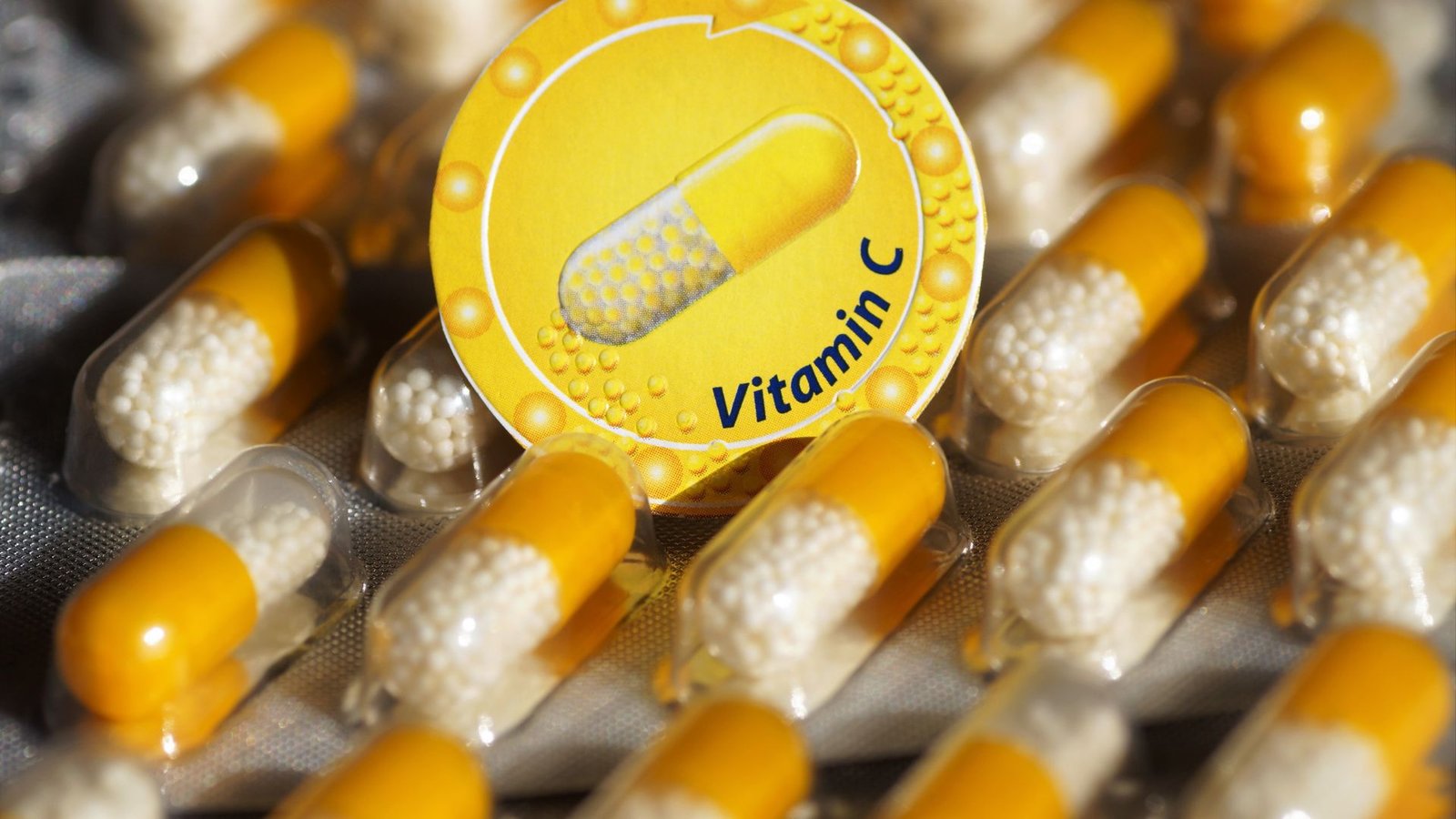
Here’s the uncomfortable math on that 1,000mg vitamin C capsule: once you cross the 1-gram mark, your body’s absorption rate drops below 50% — and popping a second capsule won’t change that. If you’ve ever wondered whether a high-dose vitamin C pill is really doing what the label promises, this is the article for you. We’ll walk through how absorption actually works, whether splitting your dose helps, why “vitamin C cures colds” is more myth than fact, what “USP Grade” really means, and who should be more careful with high doses.
This post contains affiliate links. If you make a purchase through them, we may earn a small commission — at no extra cost to you.
This article is for informational purposes only and is not medical advice. Talk to your doctor before starting any new supplement.
How Vitamin C Absorption Actually Works — and Where It Hits a Ceiling
Vitamin C doesn’t get absorbed at a flat rate no matter how much you take. At moderate intakes — the 30 to 180 milligrams you might get from food or a modest supplement — your gut absorbs roughly 70 to 90 percent of it, according to the Linus Pauling Institute at Oregon State University. That efficiency doesn’t hold as the dose climbs, though. Once a single dose crosses the 1-gram (1,000mg) mark, absorption drops to under 50 percent, based on pharmacokinetic research published in Annals of Internal Medicine. Whatever your gut doesn’t take up gets filtered out through your kidneys and leaves in your urine.
The numbers back this up. A 1.25-gram oral dose produces a peak blood concentration of about 135 micromoles per liter — only around twice what you’d get from eating 200 to 300 milligrams of vitamin C through food, according to pharmacokinetics research published in Annals of Internal Medicine. Push it further, even to 3 grams every four hours, and blood levels still cap out around 220 micromoles per liter. Your body has a built-in ceiling, enforced by active transport systems and kidney filtering, that no amount of extra capsules can override.
One caveat: this ceiling only applies to what you swallow. IV vitamin C skips the gut entirely and can push blood levels dramatically higher — but that’s a completely different delivery method than any capsule on a shelf, and not something to try without medical supervision.

So if a single 1,000mg capsule doesn’t fully get absorbed, does that mean the dose is wasted? Not exactly — but it does change how you might want to take it.
Splitting Your Dose: Does Timing Change What You Actually Absorb?
Even at under 50 percent absorption, a 1,000mg dose still delivers far more than the recommended daily allowance of 90 milligrams for men and 75 milligrams for women — roughly 11 to 13 times more. But the absorption ceiling does point to a more efficient way to take it.
Your tissues reach saturation at a fairly modest intake. Cells appear to be saturated around 100 milligrams a day, and blood levels only inch up further once you’re past about 200 milligrams daily, per the NIH Office of Dietary Supplements. Since absorption efficiency is highest at these lower, more frequent doses, splitting a larger dose into two smaller ones — say, 500mg in the morning and 500mg in the evening — will generally get more total vitamin C into your system than swallowing it all in one sitting.
If you’re looking for a straightforward, single-ingredient option you could split across the day, something like California Gold Nutrition’s Gold C capsules are just plain ascorbic acid, with no blend or proprietary formula — which makes the math easy if you wanted to try dividing a dose yourself.
Splitting doses is one variable. Another is a claim you’ve probably heard a hundred times: that vitamin C fights off a cold.
Does Vitamin C Actually Prevent (or Cure) a Cold?
This is one of the most persistent health myths out there, and the research on it is actually pretty settled. A Cochrane systematic review pooling data from more than 11,000 participants found that regular vitamin C supplementation does not reduce how often people in the general population catch a cold.
There’s one clear exception: in trials involving marathon runners, skiers, and soldiers training in subarctic conditions, prophylactic vitamin C cut cold incidence roughly in half. That points to a specific benefit for people under serious physical stress, not a general immune “boost” for everyone else.
For people who do catch a cold, taking vitamin C regularly (not just after symptoms start) was linked to a modestly shorter illness — about 8 percent shorter in adults and 14 percent in children. Starting vitamin C after you’re already sick, though, showed no consistent benefit on how long the cold lasted or how bad it felt, according to the same review. The NIH’s independent summary reaches the same conclusion.
In short: reaching for vitamin C once you feel a cold coming on probably won’t do much. Taking it consistently, especially if you’re an endurance athlete or spend a lot of time in the cold, has more evidence behind it.
Myth-busting aside, there’s a label term on vitamin C bottles that gets misunderstood just as often: “USP Grade.”
What “USP Grade” Actually Means (and What It Doesn’t)
USP stands for United States Pharmacopeia, a nonprofit that has set quality standards for medicines and supplements since 1820 — standards the FDA references in its own regulations, according to USP.org. But “USP Grade” and “USP Verified” aren’t the same claim, and the difference matters.
USP Grade describes the raw ingredient: in this case, the ascorbic acid itself meets USP-NF specifications for purity and identity before it ever goes into a capsule. That’s a real, checkable quality bar for the material. USP Verified is a different and more rigorous thing — it requires a facility audit against USP manufacturing standards, a review of quality-control documentation, and independent lab testing of the finished, encapsulated product to confirm it actually contains what the label says, with no meaningful contaminants.
A product like Gold C from California Gold Nutrition lists “USP Grade” on its label, which is worth understanding for what it does say — the raw material meets a defined purity standard — and what it doesn’t: that’s not the same as the fully independent, audited USP Verified seal. For what it’s worth, that distinction still puts “USP Grade” ahead of vaguer marketing terms like “pharmaceutical grade” or “clinically tested,” which have no standardized definition behind them at all.
Understanding the label is one thing. Knowing when a high dose isn’t the right call for you is another.
Who Should Be Careful With High-Dose Vitamin C
Vitamin C has a wide safety margin — the tolerable upper intake level for adults is 2,000 milligrams a day, according to the NIH Office of Dietary Supplements — but “wide” isn’t “unlimited,” and a few groups should pay closer attention.
Going over that threshold, or sitting near it regularly, can cause diarrhea, nausea, and stomach cramping, since unabsorbed vitamin C sitting in your gut pulls in water. Some people also notice heartburn or headaches at high intakes, per Mayo Clinic.
If you have a history of kidney stones, it’s worth knowing that the Linus Pauling Institute specifically recommends that stone-prone individuals consider avoiding doses of 1 gram or more per day — which is exactly the serving size in a single 1,000mg capsule. The research connecting vitamin C to stone risk in the general population is genuinely mixed, but for people who’ve had stones before, this is a reasonable line to know about.
A few other groups worth a mention: people with hereditary hemochromatosis (vitamin C increases iron absorption, which could worsen iron overload), anyone undergoing chemotherapy or radiation (some research suggests antioxidants could interfere with certain treatments, so the NIH recommends checking with your oncologist first), and people with G6PD deficiency, who can be more sensitive to high-dose vitamin C.
None of this makes a 1,000mg capsule dangerous for most healthy adults. It just means “more” isn’t automatically “safer,” and it’s worth knowing where your own health history fits in.
The Bottom Line
A 1,000mg vitamin C capsule isn’t a waste of money, but it’s also not delivering everything the number on the label implies. Your body absorbs less than half of a dose that large, tissue saturation happens at a much lower intake, and splitting the dose across the day is a simple way to get more out of it. The idea that vitamin C wards off colds mostly doesn’t hold up outside of serious physical exertion, “USP Grade” is a real but more modest claim than it sounds, and anyone with a history of kidney stones should know that gram-level doses sit right at the caution line.
So that 1,000mg capsule isn’t wasted money — it’s just doing less than the number on the label suggests, and now you know exactly how much.
Sources
- Vitamin C — Health Professional Fact Sheet, NIH Office of Dietary Supplements
- Vitamin C for preventing and treating the common cold — Cochrane
- Too much vitamin C: Is it harmful? — Mayo Clinic
- Vitamin C — Linus Pauling Institute, Oregon State University
- USP Verified Mark — USP.org
- Vitamin C pharmacokinetics: implications for oral and intravenous use — Annals of Internal Medicine (PubMed)
- Vitamin C pharmacokinetics in healthy volunteers — PNAS (PubMed)
- Vitamin C-induced Hemolysis: Meta-summary and Review of Literature — PMC