Two L-theanine bottles sit side by side on Amazon. Both list 200 mg. One costs $0.50 a capsule, the other $0.07. So what are you paying for?
That gap is real. On a single Amazon listing in late September 2026, L-theanine products ranged from about $0.07 to $0.96 per capsule. Some of the more expensive ones lean on a branded ingredient called AlphaWave® L-Theanine and the phrase “clinically studied.” This article looks at what L-theanine can realistically do, what the branded version’s studies actually found, and how to read a “clinically studied” label before you pay more for it.
This post contains affiliate links. If you make a purchase through them, we may earn a small commission, at no extra cost to you.
What L-Theanine Can Realistically Do
This article is for informational purposes only and is not medical advice. Talk to your doctor before starting any new supplement.
L-theanine is an amino acid found naturally in tea. Supplements usually provide 200 to 400 mg a day, and that is the range researchers tend to test.
A 2026 review in Frontiers in Nutrition pulled together human trials on cognition, mood, and sleep. Its takeaways were modest:
- Stress and anxiety: Supplementing may help reduce stress and anxiety in people under stressful conditions, without sedation.
- Sleep: People often report better sleep quality, quicker sleep onset, and better daytime functioning. The review found little evidence that L-theanine increases total sleep time.
- Focus: Small improvements in attention and reaction time, mostly when paired with caffeine.
The same review lists real limits: few studies per topic, inconsistent dose-response results, and little testing in people with clinical insomnia. Its conclusion was that there is not enough evidence to recommend L-theanine as a treatment for psychiatric conditions.
One representative trial is a 2019 study in Nutrients. It gave 30 healthy adults 200 mg a day for four weeks and placebo for four weeks, in a crossover design. Trait anxiety, depression scores, and sleep quality scores improved while taking L-theanine. It is also worth knowing that the study was supported by the company that supplied the L-theanine, and two of the authors work there. That does not make the results wrong. It does mean the sponsor and the research are closely linked, a common arrangement in supplement studies.
So the baseline is this: L-theanine has a plausible, small signal in short studies. The next question is whether a branded version does more.
Why Two 200 mg Capsules Can Have Different Prices
Here are the per-capsule prices shown on one Amazon page in late September 2026:
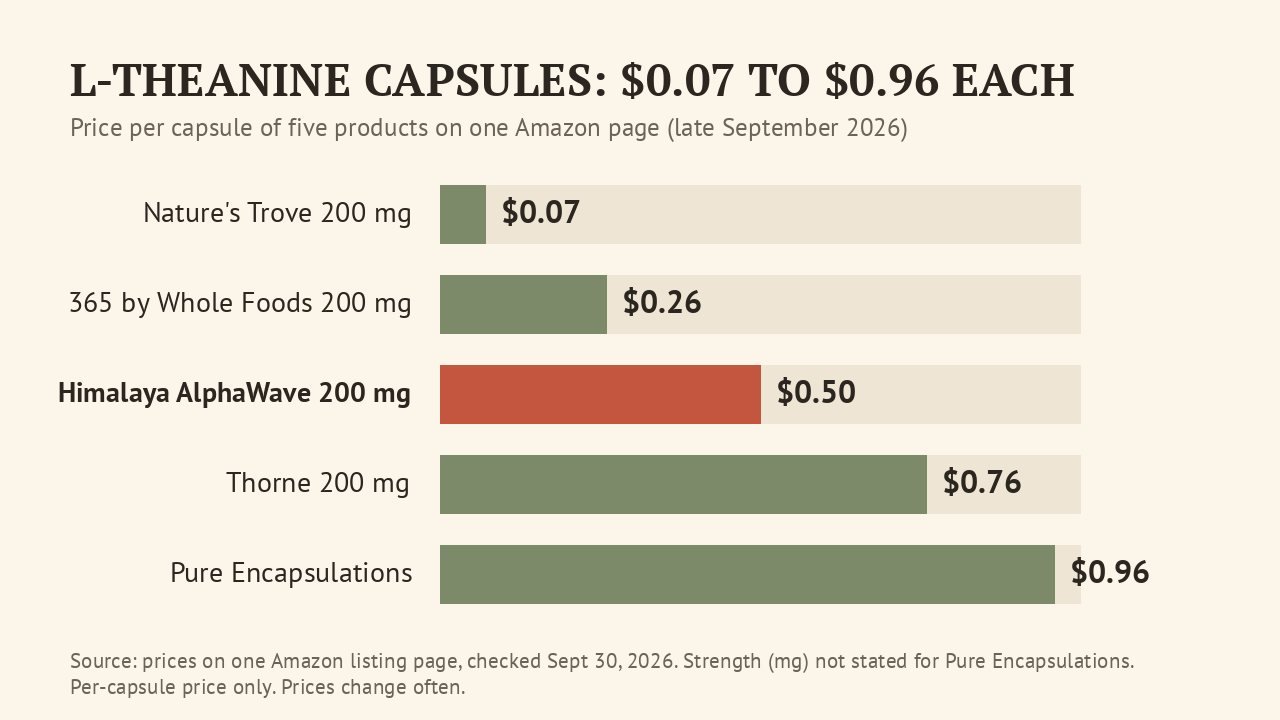
Nature’s Trove’s 200 mg (365 capsules) came out at about $0.07 per capsule, and 365 by Whole Foods Market’s 200 mg at about $0.26. Then Himalaya’s AlphaWave version at $0.50, Thorne’s 200 mg at $0.76, and Pure Encapsulations at $0.96. Price per capsule is the only fair comparison here, because we could not confirm the milligrams per capsule for every product on the page.
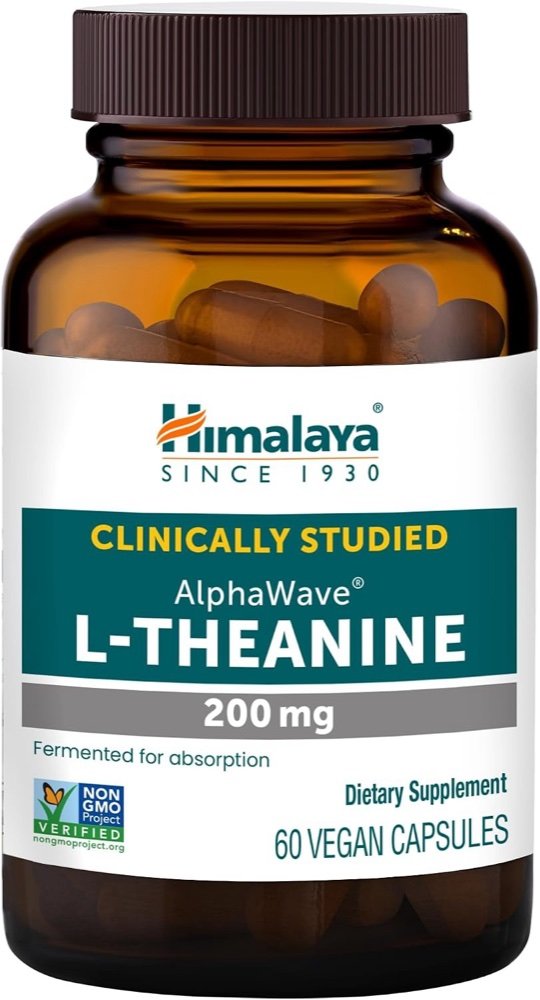
So what does the higher price buy? Himalaya L-Theanine is an example of a product built around AlphaWave. If you’re curious, this is the listing: 200 mg per capsule, one capsule a day, 60 capsules.
The listing says the L-theanine is “fermented for bioavailability,” and the bottle’s front label says “fermented for absorption.” We could not find human data supporting the idea that fermented L-theanine absorbs better, and the ingredient maker’s own product page does not make an absorption claim or describe how it is made. What the maker, Ethical Naturals Inc., does highlight, in a paid promotional feature, is an excipient-free granulation process that makes the light, powdery ingredient easier to put into capsules. That is a manufacturing detail, not evidence of stronger effects in your body.
The ingredient’s real selling point, then, is its research. So what did that research find?
What the AlphaWave Studies Actually Found
AlphaWave’s maker points to three human studies. We reviewed two of them.
The 2021 single-dose study. In a crossover trial, adults took one 200 mg dose or placebo and then did a mental arithmetic stress task. Three hours after the dose, the AlphaWave group had a greater increase in alpha brain wave activity, and one hour after, a greater drop in salivary cortisol. It was safe and well tolerated. Brain waves and cortisol are physical markers of stress. They are not the same thing as feeling less stressed.
The 2024 four-week study. This is the longer of the two. The trial enrolled 30 adults with moderate stress, 15 per group, and gave them 400 mg of AlphaWave daily or placebo for 28 days. The results are worth reading closely:
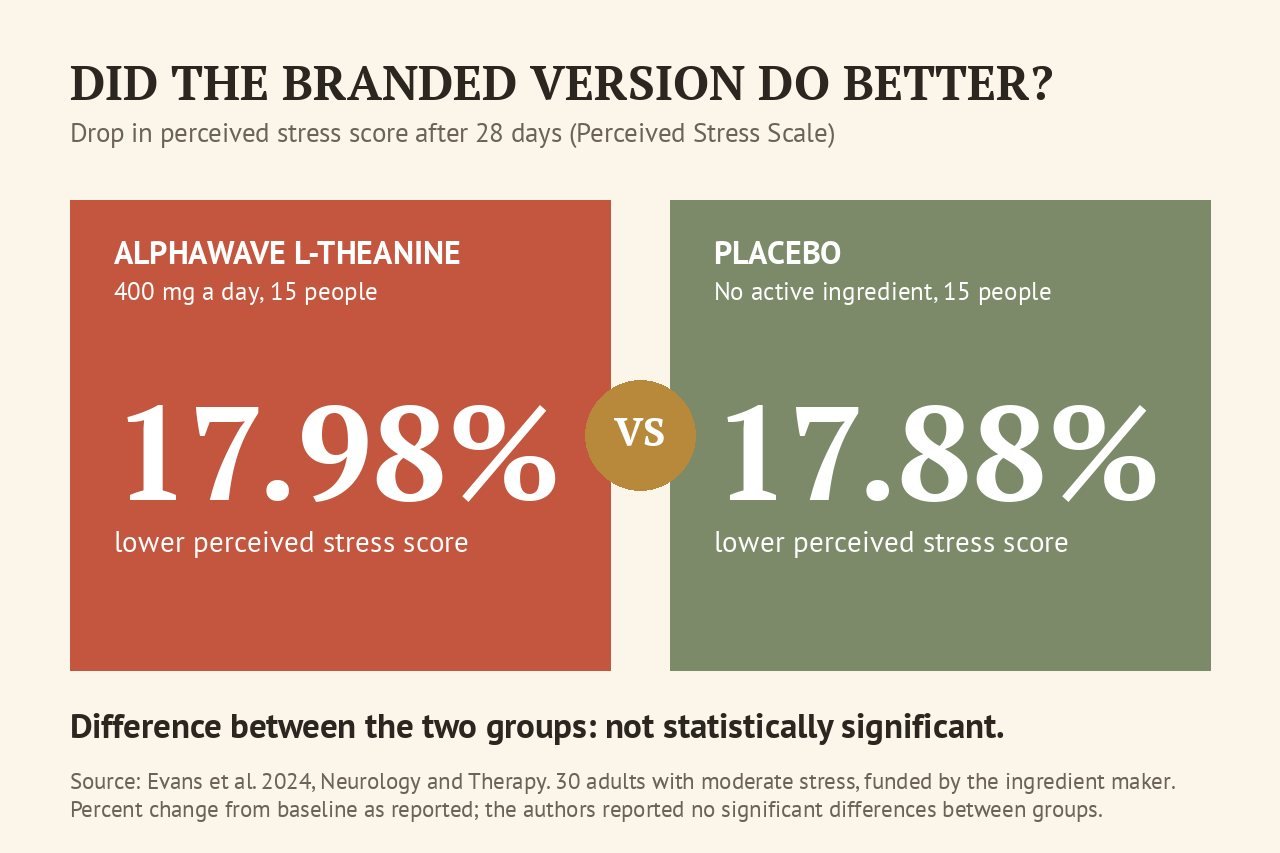
- Perceived stress: Scores fell about 17.98% in the AlphaWave group and about 17.88% in the placebo group. The authors reported “no significant differences between groups.”
- Sleep, measured by wearable: Light sleep was lower in the AlphaWave group than in placebo, and so was total time asleep at day 28. Deep sleep did not differ.
- Sleep, reported by people: No significant differences between groups.
- Attention (Stroop test): Reaction time improved in the AlphaWave group. It also improved in the placebo group by day 28.
The abstract states that supplementation “significantly decreased perceived stress” and improved sleep quality and attention. Inside the paper, the perceived stress drop was within each group, and the comparison between groups was not significant. The authors also list limits: mostly women, a small sample, and a placebo effect that may matter in moderately stressed people.
Both studies were funded by Ethical Naturals Inc., the ingredient’s maker. The listed authors are employees of that company or of a contract research firm. That is common for supplement research and does not by itself invalidate the work. But it is exactly the kind of detail that a marketing summary leaves out.
Two more points worth keeping in mind. First, none of these studies compared AlphaWave with regular L-theanine, so we cannot say it works better. Second, the product above provides 200 mg in its one daily capsule, half the dose used in the four-week study.
None of this means L-theanine is useless. It means the label does not tell you which claims to trust.
How to Judge a “Clinically Studied” Label
You can apply the same checks to almost any supplement:
- Look at the comparison between groups, not just the change over time. “Stress dropped 18%” sounds impressive until the placebo group’s stress dropped the same amount.
- Check what the placebo group did. In stress and sleep studies, placebo effects can matter a lot.
- Check the size and length. Thirty people for four weeks can suggest a direction. It cannot settle the question.
- Look at who paid and who wrote it. Sponsor-employed authors do not disqualify a study, but they are a reason to read it more carefully.
- Match the dose. If the study used 400 mg and the bottle has 200 mg, the study does not directly describe your bottle.
- Ask whether there is a head-to-head comparison. A branded ingredient that claims to beat the generic version should have been tested against it.
The same logic applies when a bigger number or a fancier name is offered as proof of quality. We looked at it in our piece on probiotic CFU counts, where a higher count does not automatically mean a better product.
Applied to the “clinically studied” and “fermented for bioavailability” wording on the Himalaya listing, the checks come out like this: the studies are real, sponsored by the ingredient maker, and did not compare against generic L-theanine, and the fermentation claim had no human evidence we could find.
Safety, Dose, and Who Should Ask First
L-theanine is generally well tolerated. The Cleveland Clinic notes that side effects are usually mild and can include drowsiness and headaches. Studies commonly use 200 to 400 mg a day for a few weeks, and higher doses up to 900 mg have been studied, though long-term safety is unclear.
Talk to a doctor or pharmacist first if you:
- take blood pressure medication or sedatives, since L-theanine may interact with them
- are pregnant or breastfeeding, because safety data are limited
- have a health condition you are managing with medication
If you try it, a practical approach is to start at 200 mg, give it a few weeks, and note whether anything actually changes: how quickly you fall asleep, how tense your afternoons feel. Placebo effects are a known limitation in this research, so a simple written log is more honest than memory.
So What Are You Paying For?
Back to the two bottles on the shelf. L-theanine itself has a small, plausible signal in short studies and is generally well tolerated. The branded version has real studies behind it, but none of them showed it does more than placebo on perceived stress, and none compared it with regular L-theanine.
So the extra dollars mostly buy a capsule process and a study you can now read for yourself. If the price difference matters to you, compare the milligrams per capsule and the price per milligram before anything else, and check with your doctor if you take any medication.
Sources
- Evans et al., “Safety and Efficacy of AlphaWave® L-Theanine Supplementation for 28 Days in Healthy Adults with Moderate Stress,” Neurology and Therapy, 2024
- Evans et al., “A Randomized, Triple-Blind, Placebo-Controlled, Crossover Study to Investigate the Efficacy of a Single Dose of AlphaWave® L-Theanine on Stress in a Healthy Adult Population,” Neurology and Therapy, 2021
- Hidese et al., “Effects of L-Theanine Administration on Stress-Related Symptoms and Cognitive Functions in Healthy Adults: A Randomized Controlled Trial,” Nutrients, 2019
- Frontiers in Nutrition, “Effects of L-theanine on cognition, mood and sleep: evidence from human trials,” 2026
- Cleveland Clinic, “L-Theanine Benefits”
- NutraIngredients, promotional feature paid for by Ethical Naturals Inc. (used only for the manufacturer’s description of its granulation process)
- Ethical Naturals Inc., AlphaWave® L-Theanine ingredient page
- Amazon product listing, Himalaya L-Theanine (prices and label wording as of late September 2026)