
Hyaluronic acid is sold as one of skincare’s simplest wins: put it on, and it pulls water in. But that’s only half the story. In dry indoor air, the same ingredient can work in reverse — pulling moisture up from deeper layers of your own skin instead of from the air around you, and then letting that moisture evaporate off the surface.
This post contains affiliate links. If you make a purchase through them, we may earn a small commission — at no extra cost to you.
Hyaluronic Acid Isn’t Always Pulling Water From the Air
This article is for informational purposes only and isn’t a substitute for professional dermatological advice. If you have a persistent skin condition, talk to a dermatologist before changing your routine.
Hyaluronic acid belongs to a category of ingredients called humectants, which work by attracting water molecules and holding onto them at the skin’s surface. Most of the time, that water comes from the air around you — which is exactly why hyaluronic acid feels so good in a humid bathroom or on a summer day.
The catch is that humectants aren’t picky about where the water comes from. A double-blind, randomized, controlled study published in the International Journal of Cosmetic Science found that even a small change in the water activity of a topical formula was enough to noticeably shift how much water the skin held and how permeable it became. Separately, research on glycerin — another common humectant — published in Scientific Reports found that humectants can actually increase water loss from skin under low-humidity conditions. In other words, when there isn’t enough moisture in the air for a humectant to grab onto, it can start pulling water from somewhere else instead: the deeper layers of your own skin.

Why “5 Forms of Hyaluronic Acid” Actually Matters
So does this happen with every hyaluronic acid product, the same way, every time? Not quite — and this is where molecular weight comes in.
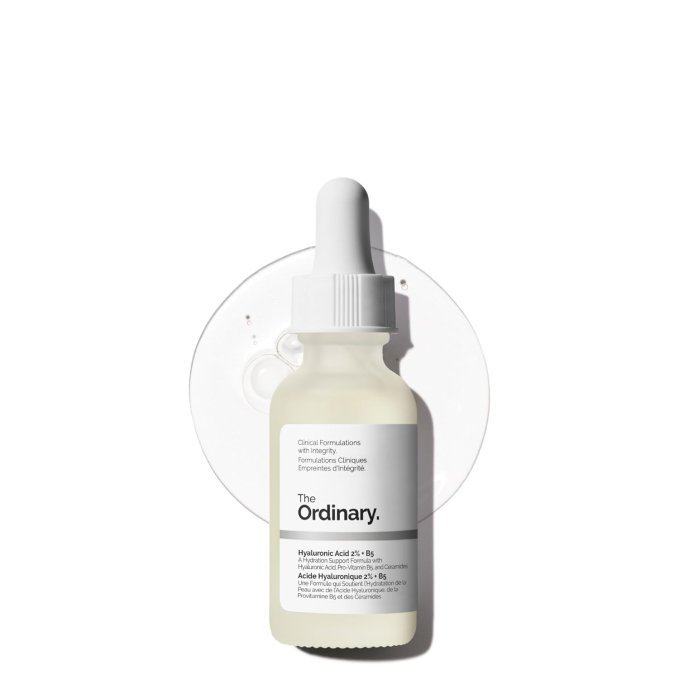
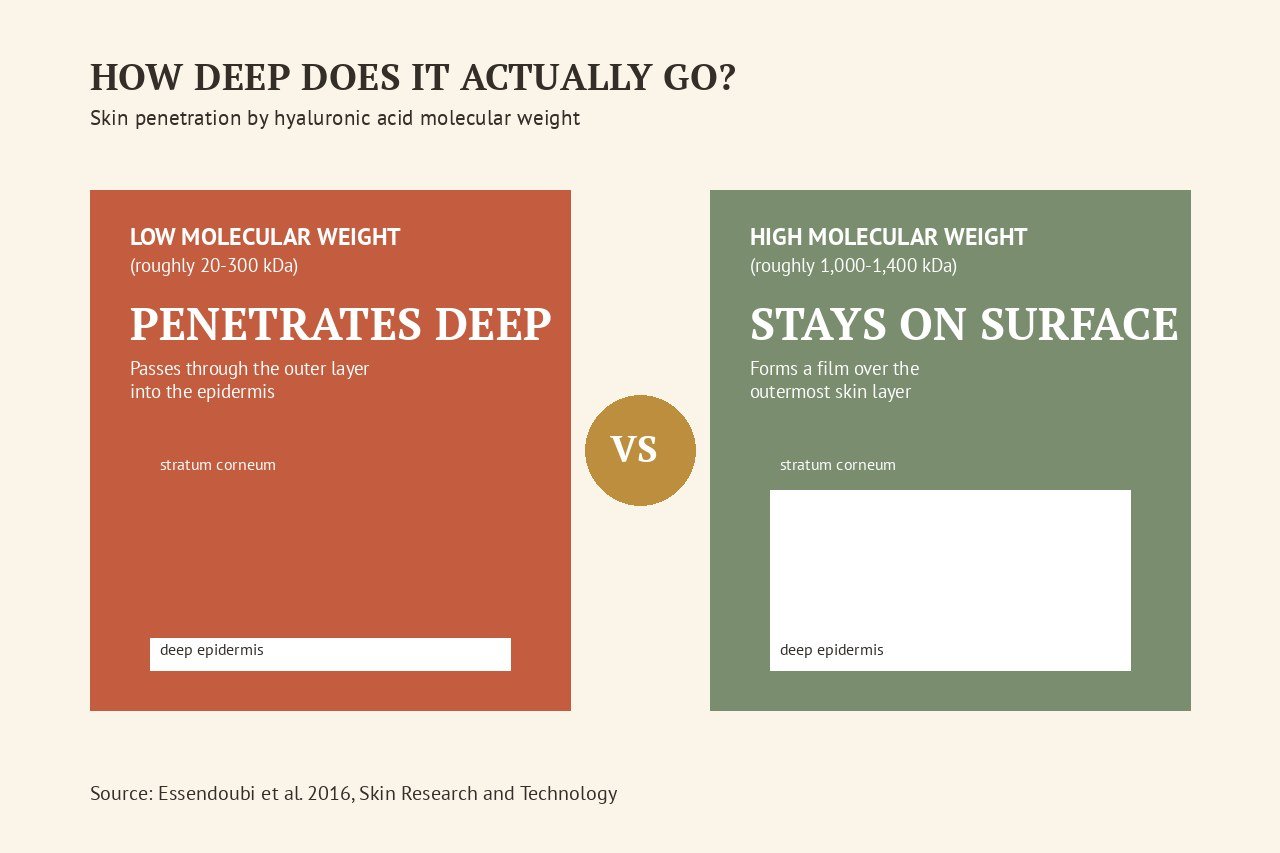
Research using Raman spectroscopy, published in Skin Research and Technology, found that low molecular weight hyaluronic acid (in the range of roughly 20 to 300 kDa) can actually pass through the outermost skin layer and reach deeper into the epidermis, while high molecular weight hyaluronic acid (1,000 to 1,400 kDa) stays on the surface and forms a film instead. That’s part of why The Ordinary’s Hyaluronic Acid 2% + B5 lists five different forms of hyaluronic acid rather than just one — the idea is to combine a surface-level film with deeper penetration instead of relying on a single molecular size.
A 2024 double-blind, randomized controlled trial in elderly adults with dry skin, comparing low molecular weight (7 kDa) and high molecular weight (1,800 kDa) hyaluronic acid, found that the low molecular weight version improved skin’s water-holding capacity more after four weeks. But here’s the detail worth paying attention to: transepidermal water loss — essentially, how fast water escapes the skin — didn’t significantly differ between groups. Holding onto more water and slowing down how fast water leaves are two different problems, and hyaluronic acid on its own mostly addresses the first one.
The Missing Piece: Sealing It In
That gap is probably why this particular serum doesn’t stop at hyaluronic acid. It also includes ceramide-related lipids (listed as phospholipids and sphingolipids) and panthenol, both of which are meant to support the skin’s own barrier rather than just attract water to the surface. Ceramides in particular act more like a seal than a sponge — they help slow down how much water escapes rather than pulling more water in.
Even so, having barrier-supporting ingredients in the formula doesn’t eliminate the need for an extra step. The Ordinary’s own usage guidance is direct about this: apply to slightly damp skin, then follow immediately with a moisturizer to seal the hydration in. Skip that sealing step, especially in a dry room, and you’re more likely to run into the exact pattern some Amazon reviewers describe — a serum that feels great going on, but leaves skin feeling tight, or peels into little rolls as it dries, or leads to a stinging sensation for some users with more reactive skin.
How to Actually Use a Hyaluronic Acid Serum Without the Backfire
The fix isn’t complicated, but it does require doing things in a specific order. Apply the serum right after cleansing, while skin is still slightly damp — not bone dry, and not dripping wet. Use a few drops rather than piling it on, since more product doesn’t mean more hydration and can just increase stickiness. Then, within a minute or two, follow with a moisturizer or an oil-based product to lock that moisture in before it has a chance to evaporate.
This sequencing matters most exactly when you’d expect: during winter, in heated indoor air, on flights, or in any room running a dehumidifier or air conditioner for long stretches. If you’re shopping for a hyaluronic acid serum to get through a dry season, pairing it with a proper moisturizer isn’t optional — it’s the part of the routine that determines whether the serum actually helps or quietly works against you.
The Bottom Line
Hyaluronic acid isn’t a flawed ingredient — it’s a humectant doing exactly what humectants do, which is pull water toward the skin from wherever it’s easiest to get. In humid conditions, that’s the air. In dry indoor air, it can be your own deeper skin layers instead, and that moisture evaporates before it does you much good. The fix isn’t switching ingredients — it’s applying it to damp skin and sealing it in with a moisturizer, especially when the air around you is working against you.
Sources
- Albèr, C., et al. “Effects of water activity and low molecular weight humectants on skin permeability and hydration dynamics – a double-blind, randomized and controlled study.” International Journal of Cosmetic Science, 2014.
- “Moisture retention of glycerin solutions with various concentrations: a comparative study.” Scientific Reports, 2022.
- Essendoubi, M., et al. “Human skin penetration of hyaluronic acid of different molecular weights as probed by Raman spectroscopy.” Skin Research and Technology, 2016.
- “Effectiveness of topical hyaluronic acid of different molecular weights in xerosis cutis treatment in elderly: a double-blind, randomized controlled trial.” 2024.
- The Ordinary. “What is Hyaluronic Acid and What Does It Do?”