
PDRN — the ingredient behind viral “salmon DNA” injections — does have real clinical trials behind it. Almost all of them, though, involve a needle.
That’s the part that tends to get lost when a toner shows up promising the same glow as an in-office treatment. If you’ve seen before-and-after clips of Rejuran-style “salmon DNA” injections and started wondering whether a bottle from the skincare aisle could get you close to the same result without a needle, you’re not alone — and it’s a fair question to ask before spending money on it. This post walks through what the actual research says about PDRN, where the evidence is genuinely strong, where it gets a lot thinner, and what that means for a product you’re expected to just pour onto a cotton pad.
This post contains affiliate links. If you make a purchase through them, we may earn a small commission — at no extra cost to you.
What PDRN Actually Is, and Why It Works When It’s Injected
This article is for informational purposes only and is not medical advice. If you have a skin condition or are considering any injectable treatment, talk to a dermatologist first.
PDRN stands for polydeoxyribonucleotide — a mixture of DNA fragments extracted from the sperm of salmon trout (Oncorhynchus mykiss) or chum salmon (Oncorhynchus keta), with molecular weights ranging from roughly 50 to 1,500 kilodaltons. Salmon DNA is used specifically because it shares enough sequence similarity with human DNA to be well tolerated by the body. Its primary mechanism of action is engaging adenosine A2A receptors and supplying nucleosides and nucleotides for what’s called the “salvage pathway,” a process that’s genuinely well established in pharmacology research — this is where PDRN’s reputation for calming inflammation and supporting tissue repair actually comes from.
▶ Watch Related Video (YouTube)
The clinical evidence for that effect is strongest when PDRN is injected. A 2022 randomized, double-blind, split-face trial in 27 participants compared a PDRN-based polynucleotide filler injected on one side of the under-eye area against a hyaluronic acid filler injected on the other. Overall visual and global aesthetic improvement scores weren’t significantly different between the two sides, but the polynucleotide side showed higher improvement rates for skin elasticity, hydration, roughness, and pore volume — a real, measured effect, but one produced by injecting the compound directly under the skin.
So the mechanism is real, and the injectable evidence holds up. The question is what happens when that same molecule is just applied on top of the skin instead.

The Physical Problem With “Just Applying” PDRN
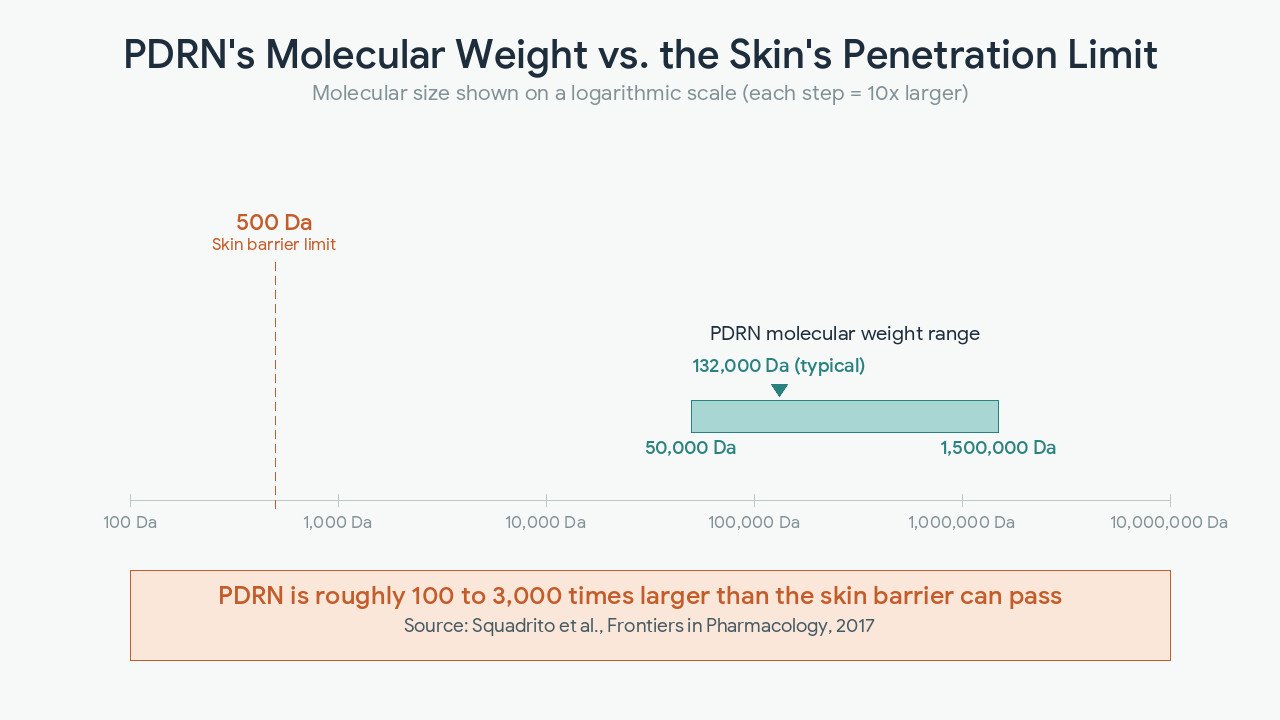
Skin’s outer layer, the stratum corneum, is built to keep things out. Dermatology researchers generally work from a rule of thumb that molecules larger than about 500 daltons can’t passively cross intact, healthy skin — it’s one of the more consistently cited thresholds in topical drug-delivery research. PDRN itself runs from roughly 50,000 to 1,500,000 daltons, with most of the material clustered between 80,000 and 200,000 daltons and a statistical peak around 132,000 daltons. Compared to that 500-dalton cutoff, PDRN isn’t just a little too big — it’s hundreds to thousands of times over it.
That size gap is the core reason injectable and topical PDRN aren’t really comparable. An injection places the molecule directly where it needs to act; a toner has to somehow get it through a barrier that’s specifically designed to block molecules of that size. Most brands don’t disclose the molecular weight or any delivery technology used to help their PDRN cross that barrier, and current cosmetic regulations don’t require them to — which makes it genuinely hard to know, from the label alone, whether a specific topical product has solved this problem or not.
That doesn’t mean topical PDRN is definitely useless — it means the evidence has to be checked on its own, separately from the injectable data. So what does that topical evidence actually look like?
The New Topical Evidence — and Its Limits
There is real human research here, and it’s recent. A randomized, double-blind, split-face trial published in PLOS ONE in July 2026 tested a 0.1% eye cream containing a specially processed, medium-length form of PDRN (referred to as PDRN-850K) in 31 healthy women with an average age of 47.5. After four weeks of twice-daily use, the PDRN cream produced greater improvements in under-eye wrinkles, skin thickness, and elasticity than a 0.5% retinol cream used as the comparison — a genuinely encouraging result for topical PDRN.
The catch is in the details. That study used a specially processed “medium-length” PDRN fraction, not the general, unprocessed salmon-derived PDRN found in most skincare products, and the researchers themselves noted that the exact delivery mechanism for topical PDRN still isn’t fully worked out. Since most commercial PDRN products don’t disclose their molecular weight or processing method — including toners like CU Dr. Solution’s PDRN Toner — there’s no way to know whether they’re using anything similar to what that trial tested, or a much larger, less penetration-friendly version of the same ingredient.
That’s the honest state of the science right now: the mechanism is real, the injectable data is solid, and topical evidence is just starting to emerge under fairly specific, narrow conditions that most store-shelf products can’t confirm they meet.
Bakuchiol: The Ingredient in the Same Bottle With Actual Topical Proof
PDRN isn’t the only headline ingredient in a toner like this one — bakuchiol usually shows up alongside it, and its evidence tells a different story. A 2019 randomized, double-blind, 12-week clinical trial in 44 participants compared a 0.5% bakuchiol cream applied twice daily against a 0.5% retinol cream applied once daily. Both ingredients significantly reduced wrinkle area and hyperpigmentation, with no statistically significant difference between the two groups — but people using retinol reported more skin scaling and stinging.
Bakuchiol is a plant-derived compound structurally unrelated to retinoids, but it produces a similar gene-expression profile in skin, which is why it’s often called a “functional retinol alternative.” It’s also a much smaller molecule than PDRN, which works in its favor for topical use. If a product like CU Dr. Solution’s PDRN toner is on your radar, it’s worth knowing that the bakuchiol in it has a real human topical trial behind it — the PDRN doesn’t, at least not yet, and this specific product doesn’t publish the bakuchiol concentration it uses, so matching it to the 0.5% tested in that trial isn’t possible from the label alone.

The Bottom Line
PDRN’s biological effects are real, and so is the clinical evidence behind injectable forms of it — the mechanism, the molecular weight, and the trial results all hold up under a direct look at the research. What doesn’t hold up as well is the assumption that a toner delivers the same thing. The size of the PDRN molecule is a real physical barrier, the topical evidence that does exist comes from a specially processed form most products don’t disclose using, and brands generally aren’t required to say which version they’re using.
None of that makes PDRN toner a scam — it just means the honest answer, right now, is “we don’t fully know yet” rather than “yes, just like the injections.” If you’re evaluating a product like this one, the more reliable move is to look at what else is in the bottle: an ingredient like bakuchiol, with its own topical human trial, is easier to trust on its own evidence than PDRN currently is in this form.
Sources
- Squadrito F, et al. “Pharmacological Activity and Clinical Use of PDRN.” Frontiers in Pharmacology. 2017;8:224.
- Lee YJ, et al. “Comparison of the effects of polynucleotide and hyaluronic acid fillers on periocular rejuvenation.” Journal of Dermatological Treatment. 2022;33(1):254-260.
- Dermatology Times. “Social Media Mythbusters: PDRN Serums.”
- Ye R, et al. PLOS ONE. 2026;21(7):e0350905.
- Dhaliwal S, et al. “Prospective, randomized, double-blind assessment of topical bakuchiol and retinol.” British Journal of Dermatology. 2019;180(2):289-296.