
Whole Foods just recalled two cheeses because they contain an egg-derived ingredient — and the label doesn’t say “egg” anywhere. If you have an egg allergy and read labels carefully, this is exactly the kind of thing that can still slip past you.
Whole Foods Just Recalled Two Cheeses — Here’s What Happened
On September 11, 2026, Whole Foods Market announced a recall of its Cabricharme cheese because the product contains egg lysozyme, an egg white protein, that wasn’t declared on the label. Two versions were affected: “Fromagerie Coop de Mean Cabricharme Raw Milk – Aged 60 days” (PLU 57953), sold in California, Connecticut, Massachusetts, New Jersey, New York, and Rhode Island, and “Belgian Cabricharme” (PLU 54670), sold in California and Arizona. Both were cut and weighed to order at the specialty cheese counter in 18 stores across those seven states, with Whole Foods Market scale labels.
A few things worth being precise about: this isn’t a case where routine testing caught a contamination issue. A store team member discovered the mislabeling. No illnesses have been reported to date. And while New York is technically on the list of affected states, that only means the specific labels above, sold by the pound at 18 specialty cheese counters — not that every Whole Foods cheese in the state is at risk. If you bought sliced or pre-packaged cheese elsewhere in the store, this recall doesn’t apply to it.
This isn’t the first grocery recall we’ve covered here either — a Walmart frozen berry recall made headlines earlier this month for a different reason (E. coli contamination). This one is about something quieter: an allergen that was there all along, just not named the way most people would expect.
Why Doesn’t the Label Just Say “Egg”?
The ingredient at the center of this recall is lysozyme, a protein extracted from egg whites. Cheesemakers use it as a natural preservative — specifically to prevent “late gas blowing,” a defect caused by certain bacteria that can bloat and spoil aged cheese. It’s a real, functional ingredient, not a contamination or a mistake in the sense of something that shouldn’t be there at all. The problem is purely about disclosure: when lysozyme comes from eggs, that needs to be called out clearly for anyone with an egg allergy, and in this case it wasn’t.
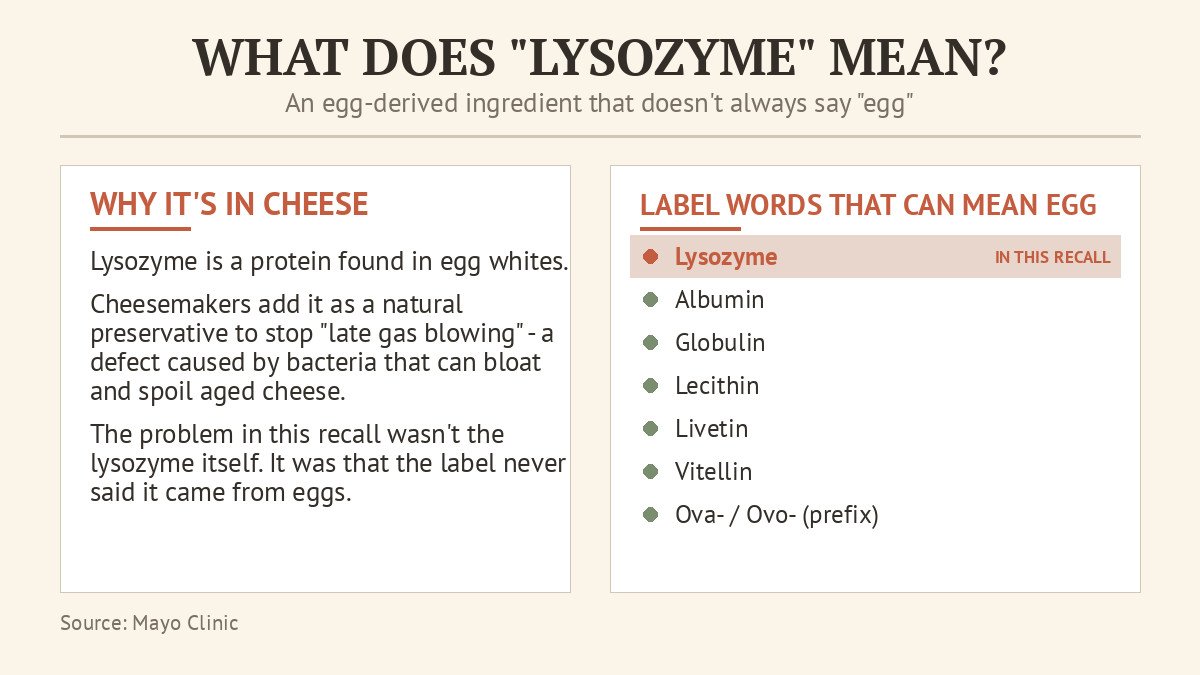
Here’s the detail that’s actually useful beyond this one recall: according to the Mayo Clinic, lysozyme is one of several ingredient terms that can indicate a product contains egg, alongside albumin, globulin, lecithin, livetin, vitellin, and anything starting with “ova” or “ovo.” None of those words look like “egg” at a glance. If you or someone in your household has an egg allergy, that’s a short list worth keeping in mind next time you’re reading a cheese, pasta, or baked goods label — not just for this specific recall, but going forward.
What an Egg Allergy Reaction Can Look Like
This article is for general informational purposes only. Allergic reactions and emergencies should always be evaluated and treated by a qualified healthcare professional.
Egg allergy symptoms usually show up within minutes to a few hours of exposure, according to the Mayo Clinic. On the milder end, that can mean hives or itchy skin bumps (the most common reaction), a stuffy or runny nose, or digestive symptoms like cramping and vomiting. Some people also experience asthma-like symptoms — coughing, wheezing, or chest tightness.
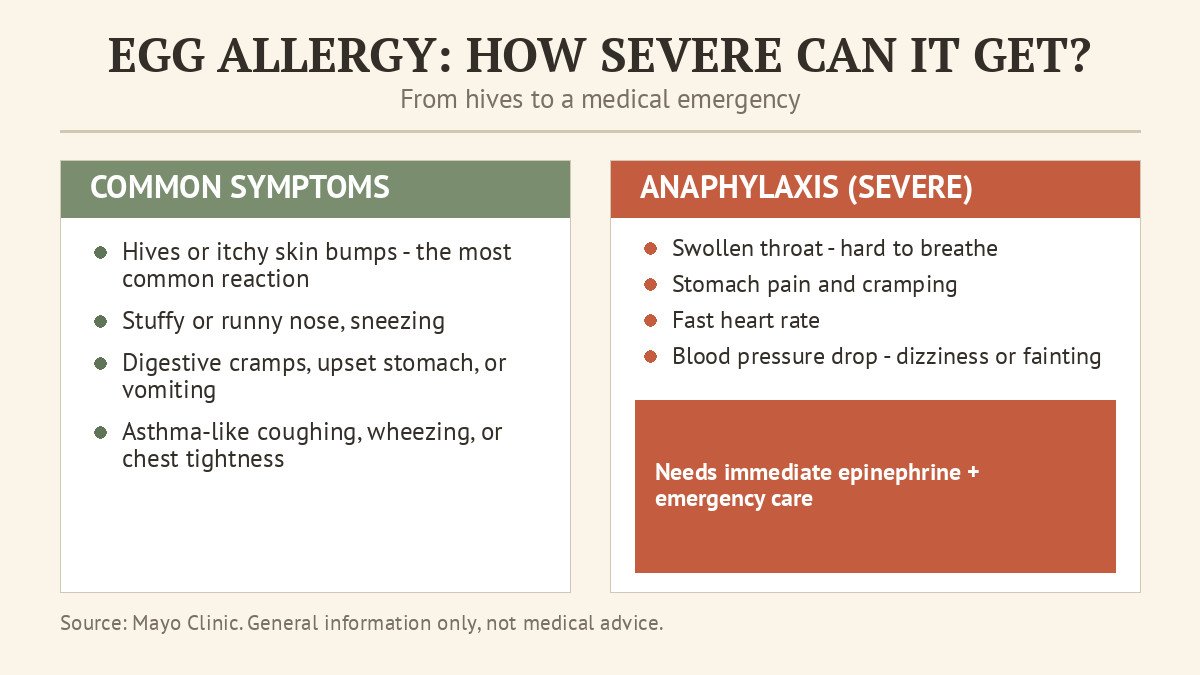
On the more serious end is anaphylaxis: a swollen throat or airway tightening that makes breathing difficult, stomach pain, a fast heart rate, and a sharp drop in blood pressure that can cause fainting. The Mayo Clinic is direct about the response here — anaphylaxis needs an immediate epinephrine shot followed by emergency care, not a wait-and-see approach. Reactions can also vary in severity from one exposure to the next, so a mild reaction in the past doesn’t rule out a more serious one later.
If You Bought This Cheese, Here’s What to Do
Whole Foods’ guidance is straightforward: you don’t need to return the product. Just destroy it. If you still have your receipt, you can get a full refund at the store where you purchased it. The company has also set up a customer line — 1-844-936-8255, available weekdays from 7 a.m. to 10 p.m. and weekends from 8 a.m. to 6 p.m. Central Time — for anyone with questions.
One detail the official recall notice doesn’t include: the exact best-by dates for the Belgian Cabricharme label (PLU 54670) weren’t specified, only that the Raw Milk Aged 60 Days version (PLU 57953) covers all dates up through October 7, 2026. If you’re not sure which label your cheese carries, the store where you bought it can look that up from your receipt.
This particular recall will resolve itself soon enough — the product’s off the shelves, and no one’s gotten sick from it so far. But the more durable takeaway is the label-reading habit: lysozyme, albumin, globulin, and the “ova-” prefix are all quiet stand-ins for egg. That’s worth remembering long after this specific batch of cheese is gone.