Take a nicotinamide riboside supplement for eight weeks and your blood NAD+ level can climb by as much as 142%. That number is real, measured, and repeated across multiple clinical trials. What’s less clear is whether a higher number on a lab readout means you’ll actually feel, move, or age any differently.
This post contains affiliate links. If you make a purchase through them, we may earn a small commission — at no extra cost to you.
What Actually Happens to Your NAD+ When You Take This
This article is for informational purposes only and is not medical advice. Talk to your doctor before starting any new supplement, especially if you take prescription medication or have an existing health condition.
NAD+ is a coenzyme every cell needs for energy production and DNA repair, and levels of it tend to decline with age — that much is well established. Nicotinamide riboside (NR, sold under the patented name Niagen) is a precursor your body converts into NAD+, and the evidence that it raises blood NAD+ is about as solid as supplement science gets.
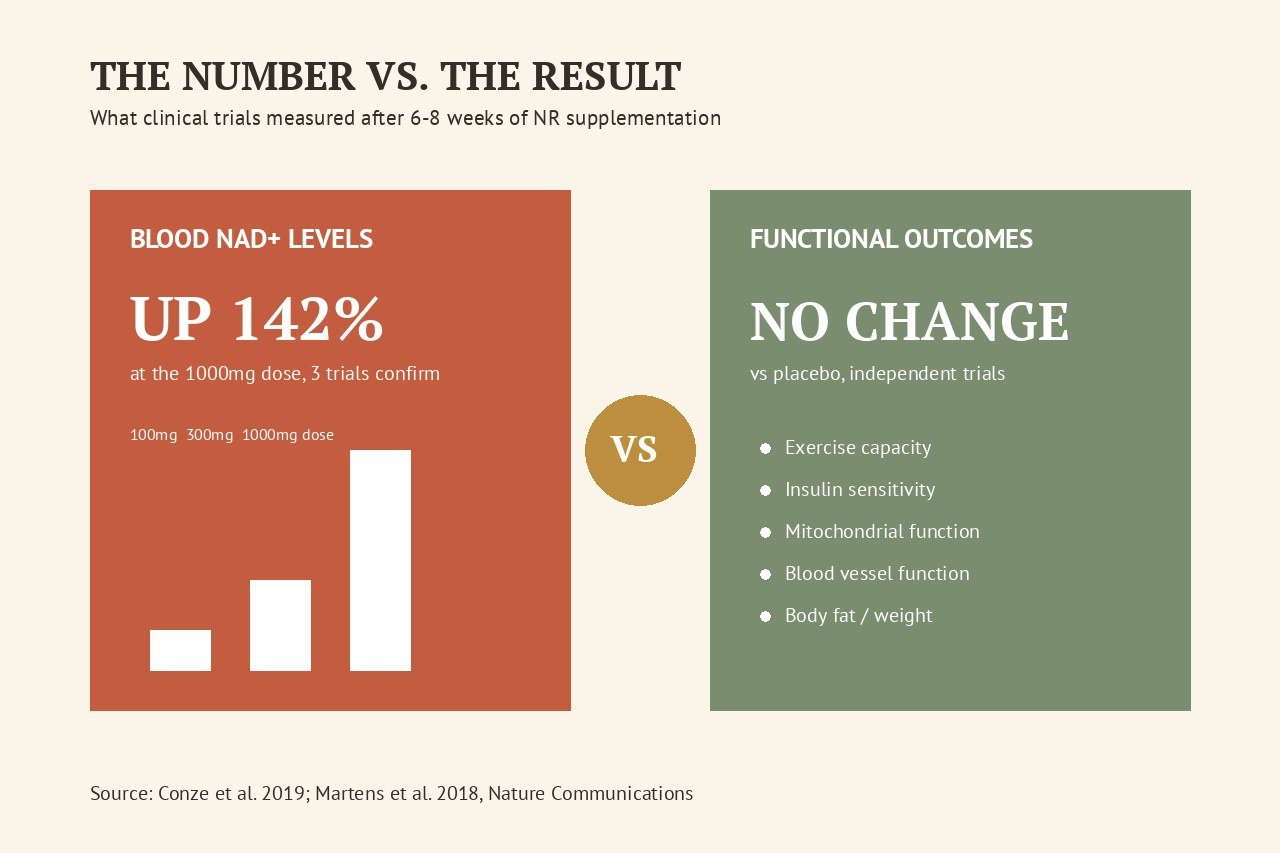
In a dose-ranging trial funded by ChromaDex (the company that makes Niagen and TRU NIAGEN) in 140 overweight adults aged 40 to 60, 100mg, 300mg, and 1000mg daily doses raised blood NAD+ by 22%, 51%, and 142% respectively after two weeks, and the increase held through the full eight-week study. A separate trial using a related formulation found NAD+ rising by roughly 40% at a standard dose and 90% at double that dose in adults aged 60 to 80. An independent study out of the University of Colorado, using a higher 1000mg daily dose in healthy adults aged 55 to 79, found blood cell NAD+ up about 60% compared to placebo. Three different research groups, three different populations, and the same basic result: this ingredient reliably does what it says on the label when it comes to raising a number in your blood.
The Gap Between a Higher Number and Feeling Different
Here’s where the story gets more complicated. The University of Colorado researchers who confirmed the NAD+ increase also measured what actually changed in the people taking it — and their own conclusion was blunt: “NR does not obviously improve aerobic exercise capacity or motor function in healthy middle-aged and older men and women.” Body weight, body fat percentage, blood sugar and insulin regulation, artery stiffness, and blood vessel function all came back statistically unchanged compared to placebo. Blood pressure showed a slight downward trend, but it didn’t hold up once the researchers corrected for multiple comparisons — they were careful to label that finding exploratory, not proven.
A separate trial in overweight and obese adults reported much the same pattern: no measurable effect on insulin sensitivity, mitochondrial function, liver or muscle fat accumulation, cardiac energy status, or inflammation markers. Another study looking specifically at muscle tissue found no change in mitochondrial respiration or structure at all. Researchers studying this ingredient have started describing a real disconnect between how promising it looks in mouse studies and how unremarkable the results have been once the same approach is tested in people.
The “Nobel Prize” Claim, Fact-Checked
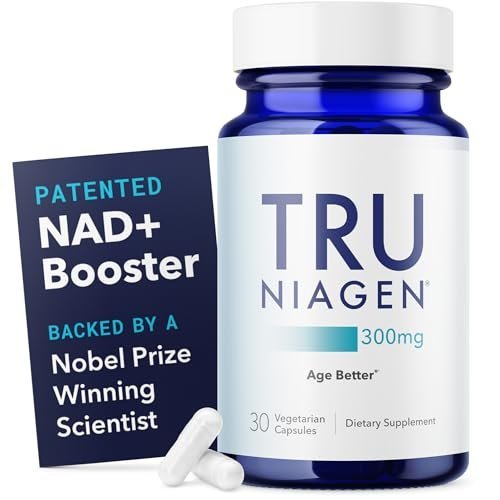
If you’ve seen the packaging for TRU NIAGEN’s NAD+ supplement, you’ve probably noticed the line about being “backed by a Nobel Prize winning scientist.” That’s technically true — ChromaDex’s scientific advisory board does include Nobel laureates. But it’s worth knowing what those prizes were actually for: one was awarded for research on RNA polymerase, and another for work on ATP synthase. Neither prize was given for NAD+ or nicotinamide riboside research specifically.
The scientist who actually discovered NR’s NAD+-boosting potential and drives the research behind this ingredient, Charles Brenner, doesn’t have a Nobel Prize — he’s ChromaDex’s chief scientific advisor and the inventor of intellectual property the company has licensed. That’s not a scandal; plenty of legitimate science comes out of industry-academic partnerships. But it does mean the dose-ranging trial showing that 142% NAD+ increase was designed, run, and paid for by the same company that sells the supplement, while the independent university studies finding no functional benefit had no such financial stake in the outcome. Knowing which is which matters when you’re deciding how much weight to give each result.
Is It Safe, and Is It Worth the Cost?
On safety, the data is actually reassuring. In the ChromaDex-funded trial, the rate of side effects was higher in the placebo group (48.6%) than in the 300mg group (40.0%), and gastrointestinal complaints were essentially identical between groups. The independent University of Colorado trial reported no serious adverse events either, and the two participants who dropped out for side effects were both taking the placebo, not the supplement. That lines up with what shows up in real customer reviews for this product — reports of stomach discomfort exist, but they’re a minority experience rather than a consistent pattern.
What’s harder to settle is the value question. At roughly $1.63 a capsule, a month of TRU NIAGEN’s 300mg NAD+ supplement runs about $49, and the honest answer is that you’re paying for a well-documented increase in a blood marker, not a guaranteed improvement in how you’ll feel. If you’re drawn to NAD+ supplementation because you’ve read about topical versions too, it’s worth knowing the oral and topical routes are answering completely different questions — we looked at that distinction in our piece on whether NAD+ or niacinamide actually does more for wrinkles, and the same “raises a number, but does it show up as a real result” pattern comes up there too.

The Bottom Line
The 142% figure isn’t marketing spin — it’s a real, repeatedly measured increase in blood NAD+ from taking nicotinamide riboside. What hasn’t held up across independent research is the leap from “your NAD+ number went up” to “you will notice a difference in energy, exercise capacity, or metabolic health.” The safety profile looks solid, and the science behind the mechanism is legitimate, but so far the human trials that matter most for judging real-world benefit haven’t found one. That’s worth knowing before deciding whether a higher lab number is worth the monthly cost to you.
Sources
- Conze, D., Brenner, C., Kruger, C.L. “Safety and Metabolism of Long-term Administration of NIAGEN (Nicotinamide Riboside Chloride) in a Randomized, Double-Blind, Placebo-controlled Clinical Trial of Healthy Overweight Adults.” Scientific Reports, 2019.
- Airhart, S.E., et al. “Repeat dose NRPT (nicotinamide riboside and pterostilbene) increases NAD+ levels in humans safely and sustainably.” 2017.
- Martens, C.R., et al. “Chronic nicotinamide riboside supplementation is well-tolerated and elevates NAD+ in healthy middle-aged and older adults.” Nature Communications, 2018.
- Dollerup, O.L., et al. “Impact of nicotinamide riboside supplementation on skeletal muscle mitochondria and whole-body glucose homeostasis: challenging the current hypothesis.” 2020.
- ChromaDex / Tru Niagen. “Our Story” — scientific advisory board disclosure.