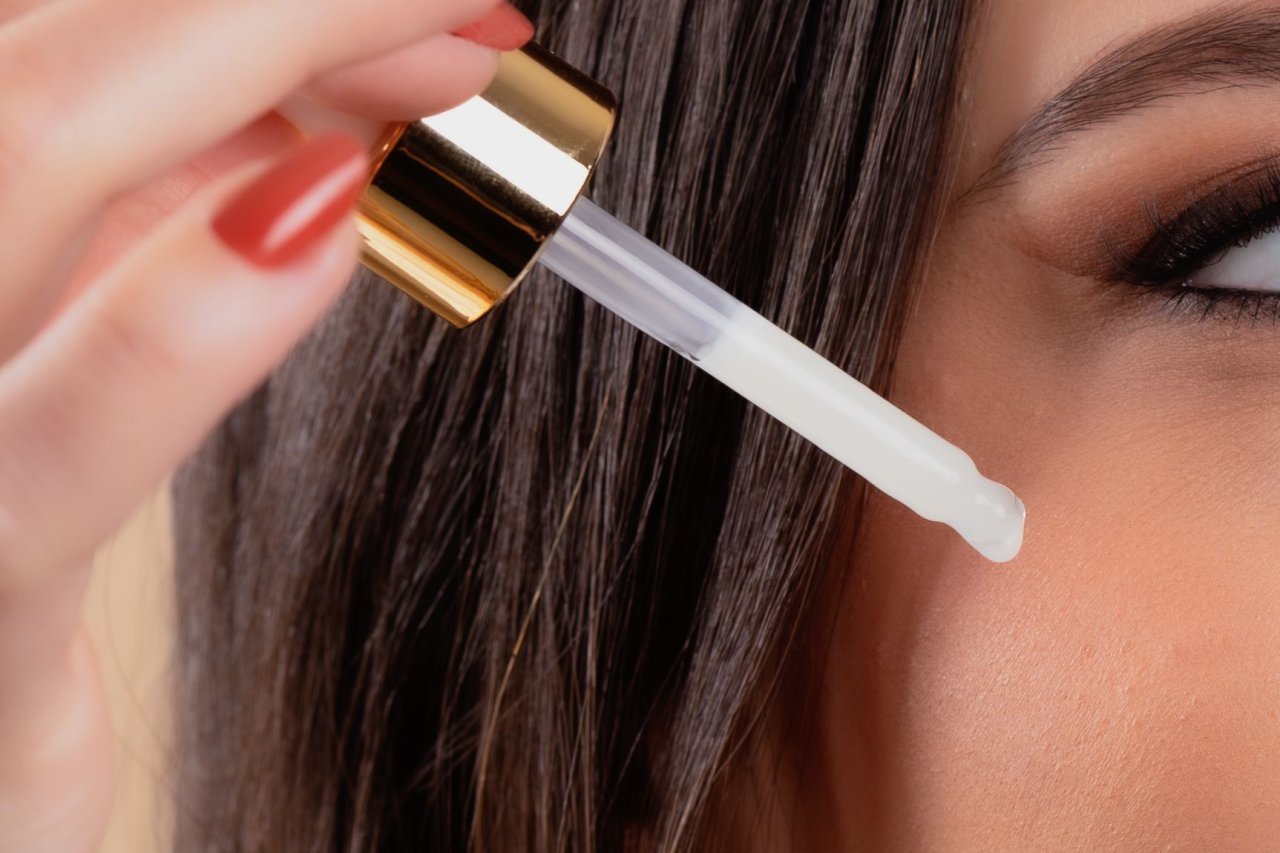
“Microneedling in a bottle” is the phrase that keeps showing up next to spicule serums, and it is a bold claim. No needles, no downtime, no appointment — just a serum that promises the same skin renewal you would get from an actual microneedling session. Some of that claim holds up under a closer look. Some of it does not.
This post contains affiliate links. If you make a purchase through them, we may earn a small commission — at no extra cost to you.
What Spicules Actually Are and How They Work
This article is for informational purposes only and is not medical advice. Talk to a dermatologist before adding a new active ingredient to your routine, especially if you have sensitive or reactive skin.
Spicules are the structural skeleton of sea sponges — tiny, needle-shaped structures made mostly of silica. In nature, sponges use them for support and defense. In skincare, that same sharp geometry gets repurposed: when massaged into the skin, spicules physically separate the cells of the outer skin layer and create microchannels between them.
The evidence for this mechanism is fairly solid. A study published in Molecular Pharmaceutics found that spicule application created roughly 850 microchannels per square millimeter of skin. Another study, published in Pharmaceutics, measured how much this actually changes absorption — using spicules to deliver insulin increased its transdermal flux from 5.0 to 457.0 nanograms per square centimeter per hour, close to a 90-fold jump.
That is the strongest, best-documented role spicules play: not as an active ingredient themselves, but as a delivery system that helps other ingredients — peptides, hyaluronic acid, growth factors — get past the skin’s outer barrier more effectively.
The Depth Gap: Spicules vs Real Microneedling
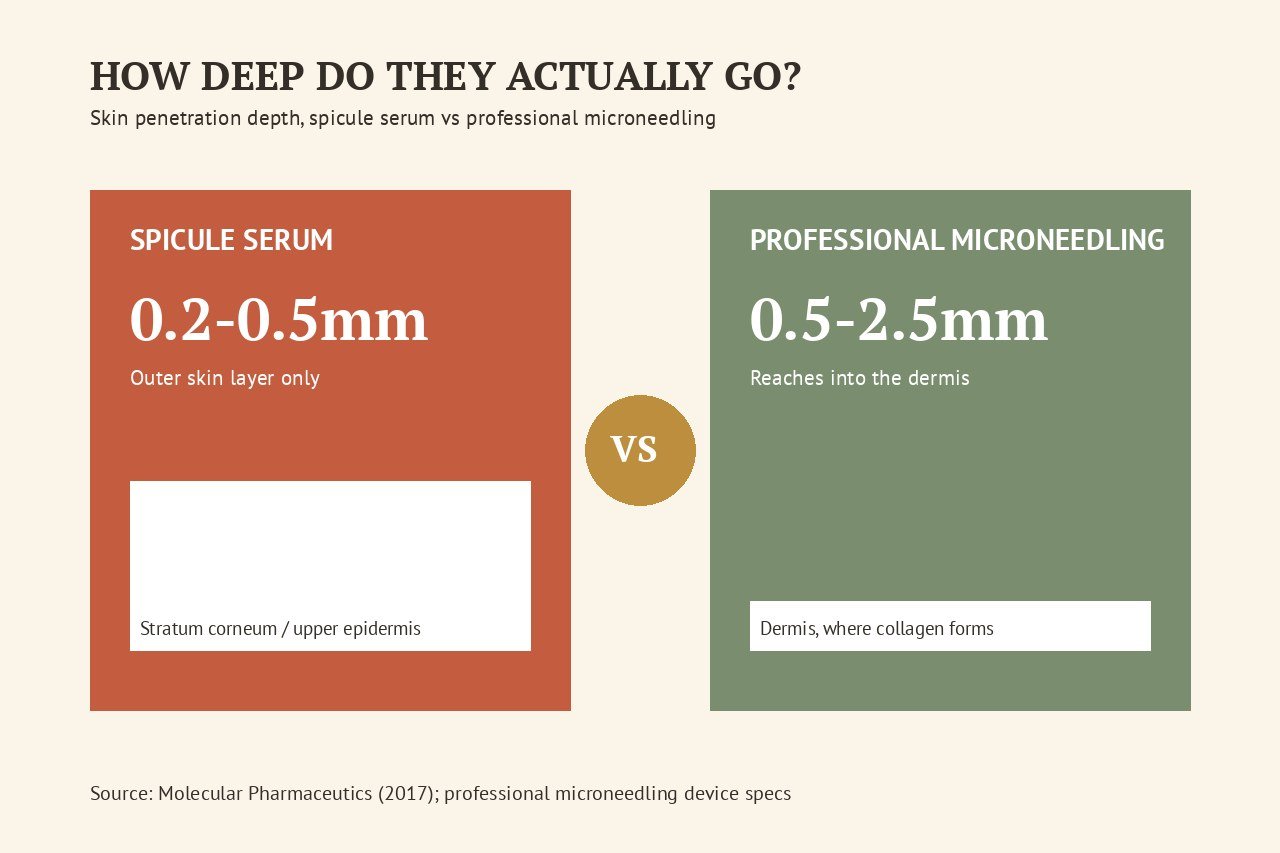
Here is where the “microneedling in a bottle” comparison starts to stretch. Spicules penetrate about 0.2 to 0.5 millimeters into skin, reaching the outer layer and sometimes the upper part of the living epidermis beneath it. Professional microneedling devices go much deeper — 0.5 to 2.5 millimeters, reaching down into the dermis.
That depth difference matters more than it might seem. Collagen remodeling, the effect most people actually want from microneedling, depends on reaching the fibroblasts that live in the dermis and triggering a controlled wound-healing response there. Spicules generally do not reach that far, so the biological trigger for real collagen induction is largely out of reach for a spicule serum used on its own.
That is not the same as saying spicules do nothing. A small split-face study published in Annals of Dermatology followed 20 participants using a growth-factor cream with and without spicules for eight weeks, and the spicule side showed better improvement in wrinkle scores around the eyes — though the difference between the two sides was modest. Separately, a 12-week study had participants use a 3% spicule cleanser with no other active ingredients, and acne grades improved meaningfully starting around week seven. Both results suggest spicules can help, particularly as a delivery boost for something else in the formula, rather than replacing what a deeper treatment does.
Is the Tingling a Good Sign or a Warning Sign?
If you have used a spicule serum, you already know the sensation — a mild prickling or tingling right after application. The question people usually have is whether that means the product is working, or whether it means something is wrong.
The honest answer is: it can be either. Studies on animal skin give a mixed picture. In guinea pig skin, spicule application caused visible redness that typically resolved within about 72 hours. In mouse skin, spicules stayed lodged in the outer skin layer for up to five days before shedding naturally, and researchers measured an increase in transepidermal water loss — a marker of a temporarily weakened skin barrier — during that window.
That lines up with what shows up in real product reviews. VT COSMETICS CICA Reedle Shot 300, one of the most widely bought spicule serums on Amazon, has thousands of reviews praising smoother, more hydrated skin — but its customer feedback is also split on sensitivity, with some users reporting no irritation at all and others describing stinging or hives. Both experiences are consistent with what the research shows: a brief, mild tingle that fades within a day is generally considered a normal sign of the microchannels forming. Sustained redness, burning, or breakouts are a different signal entirely, and they usually mean the dose or frequency is too much for that particular skin.
How to Use a Spicule Serum Without Overdoing It
Given that spicules work by temporarily disrupting the skin barrier, a few precautions go a long way toward keeping that disruption in the “helpful” category instead of the “harmful” one.
Most of the clinical guidance points toward using a spicule serum once or twice a week rather than nightly, and always following up with a barrier-supporting moisturizer afterward. Pairing it with retinoids or exfoliating acids on the same night stacks two forms of exfoliation at once, which raises the risk of irritation beyond what either ingredient would cause alone. People with rosacea, active eczema, chronically dry or menopausal skin, or any kind of compromised barrier are generally better off skipping spicules altogether or checking with a dermatologist first.
If the idea of skipping a professional treatment for something you apply at home appeals to you, it is worth knowing that spicule serums are not the only category making that promise. We looked at a similar claim with PDRN toner and whether it can really substitute for in-office injections — the pattern of “at-home version of a clinic treatment” comes up a lot in K-beauty marketing, and it is worth the same level of scrutiny each time.
If you do want to try this kind of delivery-boosting serum, VT COSMETICS CICA Reedle Shot 300 is one of the more established options, and starting at once a week — rather than jumping straight to nightly use — gives your skin a chance to show you how it will react before you commit to anything more frequent.
A basic patch test on your inner arm, left for 48 hours before trying a product on your face, remains the simplest way to find out how your own skin will react before committing to a routine.
The Bottom Line
Spicules are real, and the science behind how they create microchannels in skin is solid. What is exaggerated is the idea that a serum can replicate what a 0.5 to 2.5 millimeter deep microneedling session does at 0.2 to 0.5 millimeters. Used as a delivery boost for other ingredients, applied once or twice a week, and followed by a good moisturizer, a spicule serum like this one can be a reasonable part of a routine. Used as a stand-in for an actual collagen-inducing treatment, it is likely to disappoint — and if the tingling turns into lasting redness, that is your skin telling you to back off, not a sign to push through.
Sources
- Zhang, S., et al. “Skin Delivery of Hydrophilic Biomacromolecules Using Marine Sponge Spicules.” Molecular Pharmaceutics, 2017.
- Zhang, C., et al. “Enhanced Skin Delivery of Therapeutic Peptides Using Spicule-Based Topical Delivery Systems.” Pharmaceutics, 2021.
- Ha, J.M., et al. “The Effect of Micro-Spicule Containing Epidermal Growth Factor on Periocular Wrinkles.” Annals of Dermatology, 2017.
- SkinCareful. “Spicules in Skincare: Science vs the Hype.”
- Chemist Confessions (Gloria Lu). “Reedle Shot Deep Dive! Science of Spicules in Skincare.”