
A recall getting bigger doesn’t automatically mean more people got sick from it. That’s exactly the case with the latest expansion of the Walmart berry recall — the FDA’s own announcement says no illnesses have been tied to this specific product. Here’s what was actually recalled, what that “precautionary” label really means, and what to do if you have it in your freezer.
What Was Actually Recalled
On September 2, the supplier Frutas y Hortalizas del Sur S.A. expanded an earlier recall to include one lot of Great Value Organic Triple Berry Blend — a 10-ounce bag of strawberries, blackberries, and blueberries sold at Walmart — over possible contamination with Escherichia coli O145:H28, a Shiga toxin-producing strain (STEC).
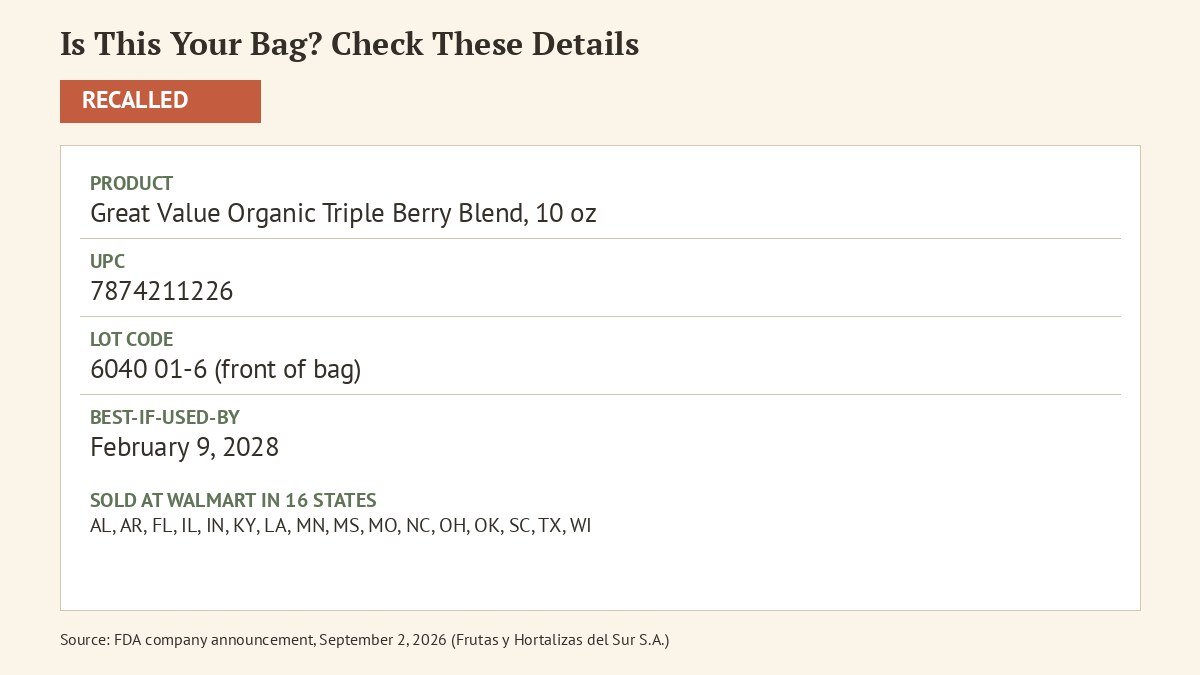
If you want to check your own freezer, here’s exactly what to look for:
- Product: Great Value Organic Triple Berry Blend, 10 oz
- UPC: 7874211226
- Lot code: 6040 01-6 (printed on the front of the bag)
- Best-if-used-by date: February 9, 2028
- Sold at Walmart stores in Alabama, Arkansas, Florida, Illinois, Indiana, Kentucky, Louisiana, Minnesota, Mississippi, Missouri, North Carolina, Ohio, Oklahoma, South Carolina, Texas, and Wisconsin
New York hasn’t been on the distribution list at any stage of this outbreak — not for the original Publix recall in July, not for its expansion later that month, and not for this Walmart product either. So if you’re shopping in New York, none of these three recalls have applied to stores there so far. That said, the investigation is still open, and matching the exact UPC and lot code against your own bag is always the more reliable check than relying on a state list alone.
So why did a product with no reported illnesses get pulled now? That’s worth untangling.
Why This Was Added Now — and What “Precautionary” Actually Means
This didn’t start with the Walmart product. It started on July 3, when Frutas y Hortalizas del Sur recalled frozen GreenWise Organic IQF Blueberries sold at Publix. On July 29, Publix expanded that recall to cover all lots of its GreenWise blueberries and mixed berries. Then on September 2, the supplier expanded again — this time pulling in the Great Value Triple Berry Blend at Walmart, because it traces back to the same source.
Here’s the part that’s easy to miss in a headline: the FDA’s own company announcement states plainly that “there are no illnesses associated with this specific product to date, and this market action is taken as a precautionary measure following traceback information of the previous recall.” In plain terms: nobody has been reported sick from this Walmart bag specifically. It got recalled because it shares a supply chain with product that has been linked to illness, not because it has been confirmed to have made anyone sick itself.
That distinction matters. A recall expanding doesn’t mean the outbreak is expanding at the same pace — it can just mean the investigation traced the contamination risk further upstream. So what does the actual outbreak look like?
The Outbreak So Far, By the Numbers
According to the CDC’s outbreak page, updated September 3, this is where things stand: 17 people infected, 6 hospitalized, 0 deaths, across 2 states. The investigation is still listed as open.
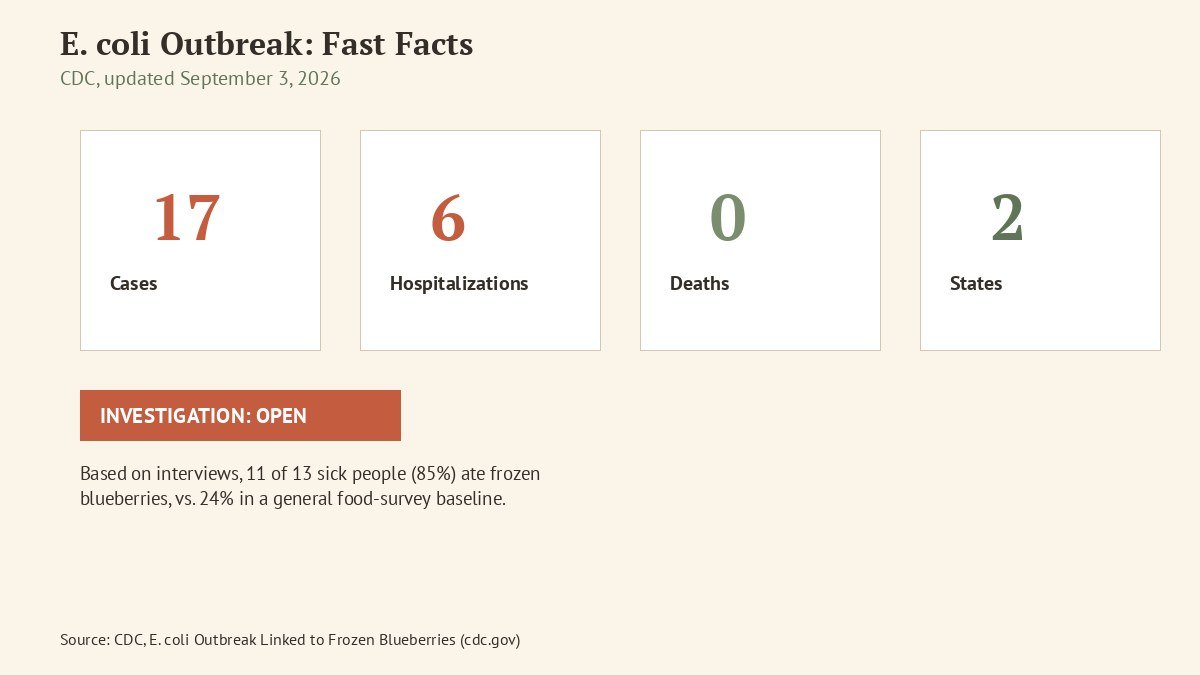
The link to frozen blueberries specifically isn’t a guess — it’s based on interviews with the people who got sick. Of 13 people interviewed, 11 (85%) reported eating frozen blueberries, compared to just 24% of people in a general food-consumption survey the CDC uses as a baseline. That gap is what pointed investigators toward blueberries as the likely source before any recall was announced.
Numbers like “17 cases” can sound abstract until you know what those cases actually feel like — and what should push you to take them seriously.
Symptoms to Watch For (And When to Call a Doctor)
This section is for general informational purposes and isn’t a substitute for medical advice. If you’re concerned about symptoms, contact a healthcare provider.
E. coli O145 is a Shiga toxin-producing strain, and per the CDC, most people who get infected develop severe stomach cramps, diarrhea (which can be bloody), and vomiting. Symptoms usually start 3 to 4 days after exposure, and most people recover within 5 to 7 days without any treatment.
In some cases, though, the infection can lead to a more serious kidney complication called hemolytic uremic syndrome (HUS) — this risk is higher for young children, older adults, and people with weakened immune systems. The CDC recommends calling a healthcare provider if you or someone in your household has:
- Diarrhea with a fever above 102°F
- Diarrhea lasting more than 3 days without improvement
- Bloody diarrhea
- Vomiting severe enough that you can’t keep liquids down
- Signs of dehydration, like reduced urination, a dry mouth, or feeling dizzy when standing up
If none of that applies to you, the more immediate question is simpler: what do you actually do with the bag in your freezer?
What to Do If You Have the Recalled Product
If your bag matches the UPC and lot code above, the CDC’s guidance is straightforward: don’t eat it. Throw it away or take it back to Walmart for a refund. Since frozen berries can spread bacteria to anything they’ve touched, it’s also worth washing any containers, cutting boards, or surfaces that came into contact with the product using hot, soapy water.
Going back to where this started: a bigger recall isn’t automatically a bigger health scare. In this case, the FDA has been explicit that the Walmart product itself hasn’t been linked to any reported illness — it was added out of caution, not confirmation. That’s worth knowing so you can take the right amount of concern here: check the label carefully, don’t eat anything that matches, and don’t lose sleep over a bag that doesn’t match at all.