
Taco Bell’s new Churro Ice Cream Taco has been on menus since September 1 — and as of this writing, there’s still no published nutrition label for it. If you just ordered one and you’re wondering exactly how much damage that little waffle cone did, you’re not going to find an official answer from Taco Bell yet.
That doesn’t mean you’re totally in the dark, though. There’s enough confirmed comparison data out there to get a reasonable sense of where this thing probably lands.
What’s Actually in the New Ice Cream Taco
The Churro Ice Cream Taco is a collaboration between Taco Bell and the ice cream brand Salt & Straw. It’s a crispy waffle cone shell filled with a newly developed Churro Ice Cream, topped with puffed rice, and finished with a dark chocolate-flavored coating. It costs $3.99 at participating locations.
There’s also a companion drink, the Salt & Straw Choco-Waffle Chiller, but that one’s only available at select Live Más Café locations in a handful of states — not the standard nationwide menu. Both are part of a limited-time run; Taco Bell has flagged September 8 as a last chance to grab the ice cream taco through a rewards-app promotion, though an exact end date for regular sales hasn’t been announced.
This is the second time Taco Bell and Salt & Straw have teamed up on an ice cream taco. Last year’s version, a cinnamon-ancho flavor called the Tacolate, became enough of a hit that it’s now sold year-round at Salt & Straw’s own scoop shops.
That’s the useful part — because it means there’s real, confirmed data on a nearly identical product from the same makers.
Why There’s No Nutrition Label Yet (And What That Actually Means)
Brand-new fast food items frequently launch without published nutrition facts. Taco Bell’s official newsroom announcement describes the product in detail but doesn’t list calories, fat, or sugar, and fastfoodnutrition.org — which tracks the chain’s full menu — doesn’t have it listed either as of this writing. This is a normal lag, not a sign that something’s being hidden — full nutrition breakdowns for new items typically show up within days to weeks of launch, not on day one.
So the honest answer to “how many calories is it” is: nobody official is saying, yet. But that’s not the end of the story.
What Similar Ice Cream Tacos Actually Contain
The Direct Predecessor
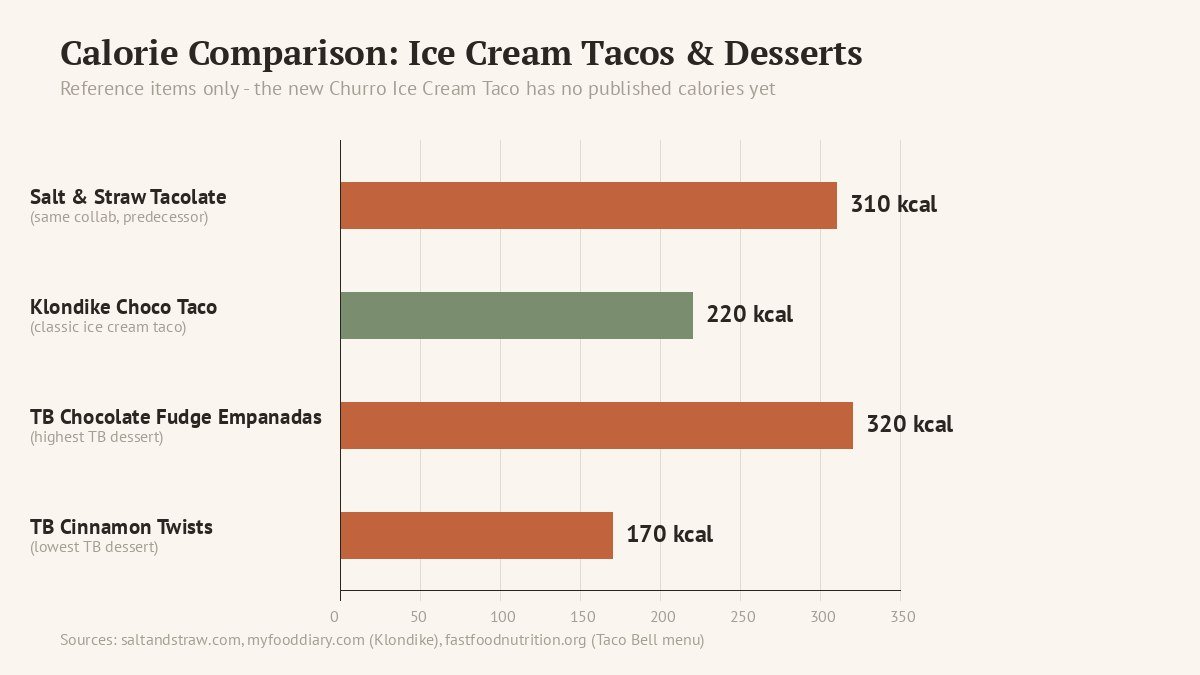
Salt & Straw sells its own year-round version of this same idea — a waffle cone ice cream taco dipped in chocolate — called the Tacolate. According to Salt & Straw’s official product page, one Tacolate contains 310 calories. It’s not the exact same flavor as the new Churro version (Tacolate is cinnamon-ancho, not churro), but it’s the closest thing to an apples-to-apples comparison that exists: same format, same brand, same ice cream makers.
The Classic Choco Taco
Before Salt & Straw, there was Klondike’s Choco Taco — the ice cream taco that basically invented the category before it was discontinued and became a nostalgia icon (which is part of why this collaboration gets so much attention in the first place). A single 74-gram Choco Taco contains 220 calories, 11 grams of total fat, 8 grams of saturated fat, 90 milligrams of sodium, 30 grams of total carbohydrate, and 17 grams of total sugar — 14 grams of which are added sugar.
Taco Bell’s Own Dessert Menu
For a third reference point, Taco Bell’s existing dessert lineup — items like Salted Caramel Churros, Cinnamon Twists, and its various empanadas — runs roughly 170 to 320 calories per item. The new ice cream taco is priced and portioned in line with that range, which is another reason to expect it lands somewhere similar.
Put together, none of these numbers is the actual Churro Ice Cream Taco. But three independent reference points landing in the same general zone — low-to-mid 200s through low 300s calories, with a meaningful chunk of that from added sugar — makes it a reasonable range to expect until Taco Bell publishes the real thing.
How This Stacks Up Against Daily Sugar Limits
This article is for informational purposes only and is not medical advice. Talk to your doctor before making major dietary changes.
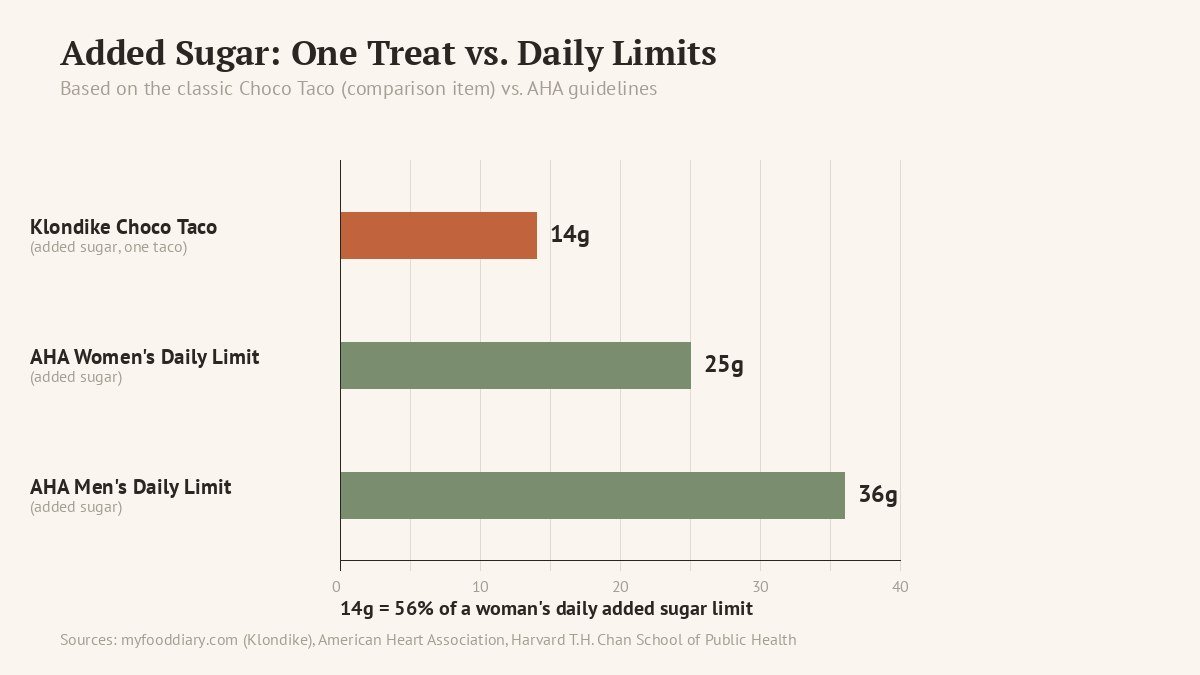
The American Heart Association recommends that most women keep added sugar under 25 grams a day, and most men under 36 grams. The Dietary Guidelines for Americans set a looser ceiling of about 50 grams a day for a 2,000-calorie diet. Desserts and sweet snacks like ice cream are called out specifically as one of the biggest sources of added sugar in the average American diet, according to the Harvard T.H. Chan School of Public Health.
Using the Choco Taco’s 14 grams of added sugar as a stand-in, that single treat would already use up 56% of a woman’s daily recommended limit — and this is before accounting for whatever puffed rice and dark chocolate coating add to the new version. It’s not an exact number for the Churro Ice Cream Taco, but it’s a useful gut check: this is squarely in “occasional treat” territory, not an every-day food.
So, Is It Worth Ordering?
There’s no official verdict yet, and there might not be one for a while — new items don’t always get nutrition labels quickly. But based on everything that actually is confirmed — the direct predecessor at 310 calories, the classic Choco Taco at 220, and Taco Bell’s own dessert menu clustering in the same range — a reasonable expectation is somewhere in the low-to-mid 200s to low 300s calories, with a solid share of that coming from added sugar.
If you already ordered one and you’re standing there wondering exactly how much damage it did: probably not catastrophic, probably not negligible either. It’s a limited-time dessert, not a daily habit, and treating it that way is the most useful takeaway here — more useful than either an exact number or a vague shrug.
Sources
- Taco Bell Introduces the Salt & Straw Churro Ice Cream Taco Nationwide — Taco Bell Newsroom
- The Tacolate — Salt & Straw official product page
- Taco Bell Nutrition Facts & Calories — fastfoodnutrition.org
- Klondike Original Choco Taco Nutrition Facts — MyFoodDiary
- Added Sugar — The Nutrition Source, Harvard T.H. Chan School of Public Health
- How Much Sugar Is Too Much? — American Heart Association